
Hospital leaders are overwhelmed by data while starved of insights. Every patient interaction and supply chain movement generates terabytes of information. However, this data remains locked in disparate systems that fail to communicate with one another.
The result is decision-making that looks backward instead of forward. Relying on weeks-old reports forces hospitals into a permanent state of reaction. Leaders respond to capacity crises and budget variances after the damage has been done. As costs rise and margins tighten, efficiency is now both a goal in itself and an imperative for financial survival.
Beyond robotic surgery or diagnostic AI, the most critical digital transformation in healthcare happens in the boardroom. By digitizing the management layer, leaders shift to proactive orchestration. This step, enabled by healthcare strategic planning software, is key to unlocking optimal operational efficiency.
In This Article
- The High Cost of Reactive Decision-Making in Healthcare
- Shifting From Hindsight to Foresight
- Eliminating Silos Between Clinical and Operational Data
- 3 Ways Digital Tools Streamline Hospital Operational Efficiency
- Bridging Strategy and Execution
- Leading Your Digital Transformation With AchieveIt
The High Cost of Reactive Decision-Making in Healthcare
Traditional hospital operations rely on historical reporting. Department heads spend time compiling last month’s data for a quarterly meeting, but by the time leadership reviews bed utilization or overtime metrics, the operational reality has shifted.
The Data-Rich, Insight-Poor Paradox
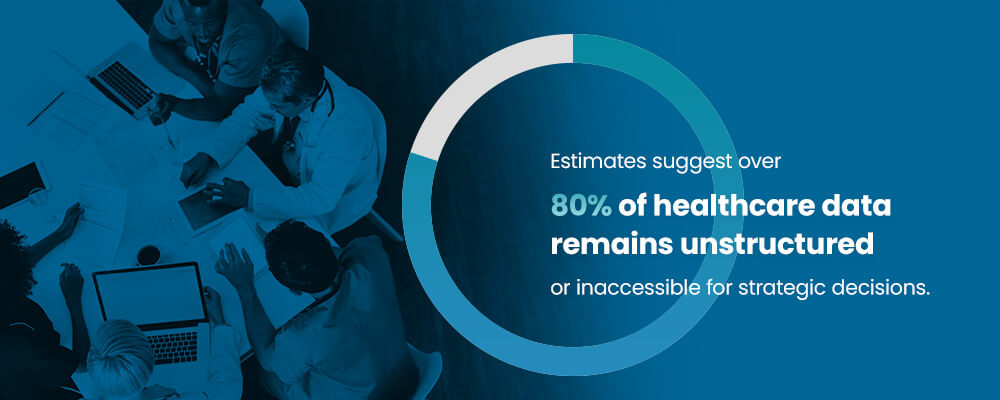
Hospitals are data-intensive, tracking everything from admission rates to readmission penalties. Estimates suggest over 80% of healthcare data remains unstructured or inaccessible for strategic decisions.
This data sits in silos. Clinical details live in electronic health records (EHRs). Financials sit in the general ledger. Operational metrics hide in departmental spreadsheets. Without a digital layer to unify this information, leaders lack a complete view of their organization. They see an overtime spike in March, but cannot correlate it with the patient discharge bottleneck that occurred weeks prior.
The Operational Lag
Manual reporting creates a dangerous operational lag. For example, patient acuity rises, requiring higher ICU nurse-to-patient ratios. Staffing coordinators use expensive agency labor to fill the gaps. The variance isn’t flagged until the month-end close, and the report reaches executives weeks later. As a result, the hospital loses profit for 60 days before a strategic intervention is discussed.
In an environment of single-digit margins, this lag is unaffordable. The importance of healthcare strategic planning lies in closing the gap between identifying a problem and executing a solution.
The Financial Impact of Inefficiency
Operational friction has a price tag. As hospitals face unprecedented financial headwinds due to labor costs and inflation, inefficiencies once absorbed by healthier margins are now existential threats.
Reactive decision-making compounds these costs:
- Supply chain waste leads to expired stock when orders are based on historical averages.
- Inefficient bed turnover forces hospitals to divert patients, resulting in immediate revenue loss.
- Staff burnout forces mandatory overtime, drives turnover and recruitment costs.
To reverse these trends, hospitals need not rely on analyses of past performance. They can transition to a nervous system that enables real-time decision-making.
Shifting From Hindsight to Foresight
Digital innovation in healthcare is about digitizing the decisions that govern the hospital. A facility with the most advanced MRI machines may fail operationally if its management relies on paper checklists. Digital transformation must extend to the administrative and strategic layers of operation. It involves implementing systems that ingest data from across the enterprise to answer complex questions instantly.
Predictive vs. Reactive
The goal is to move from month-end reports to real-time dashboards. A reactive report shows the emergency department (ED) was overcrowded last Friday. A predictivealgorithm analyzes local flu trends and current bed status to alert leadership onTuesday that the ED will hit capacity by Friday.
This distinction is critical. The most effective systems enhance human judgment rather than replace it. Algorithms process the volume while leaders provide the context.
An Example of Staffing Intelligence
Consider a nursing director managing a multiunit floor. Using a traditional approach, they schedule staff based on last year’s census data. When a surge hits, they scramble to call in off-duty nurses, paying premium rates. Healthcare digital transformation software provides real-time hospital analytics of current patient acuity scores and pending ED admissions to predict a staffing shortage 12 hours in advance. The director adjusts the schedule during standard hours, avoiding overtime and ensuring patient safety ratios are met before the crisis begins.
Eliminating Silos Between Clinical and Operational Data
A hospital is a single organism, yet its organs often operate independently. Clinical teams focus on medical outcomes using the EHR, while operational teams focus on logistics and finance using an enterprise resource planning (ERP) tool.
Digital transformation can improve hospitals’ operational decisions by enabling these systems to converge on a single source of truth. This integration solves three critical disconnects:
- The language barrier: Clinical systems and operational systems often speak different languages. A unified platform ensures that if a clinical team changes a surgical protocol, the supply team is immediately alerted to adjust procurement and sterilization workflows.
- Inputs to outputs: Digital transformation creates an overlay where clinical inputs — such as surgery volume being up 10% — instantly translate into operational requirements — 10% more sterile processing capacity is needed.
- The knock-on effect: Operational machinery must support patient outcomes. By integrating data streams, leaders can see the full chain of causality. For example, if laundry services are delayed, beds can’t be turned over. If beds aren’t turned over, patients wait in the ED. When patients wait, satisfaction scores drop and revenue leaks.
3 Ways Digital Tools Streamline Hospital Operational Efficiency
When data flows freely, efficiency follows. Digital transformation software removes friction from daily workflows. By automating the manual tasks that slow down decision-making, hospitals can unlock immediate operational capacity without adding a single bed or staff member.
1. Automated Resource Allocation
Bed management can often feel like a game of Tetris played via phone calls and whiteboards. This manual process is slow, error-prone and a primary driver of ED overcrowding. Digital platforms change this dynamic by using real-time location systems (RTLSs) and census data to automate patient placement logic.
Automated tracking significantly reduces the time staff spend searching for beds or equipment. This digital visibility optimizes bed turnover and maximizes operating room (OR) utilization rates — two key revenue drivers for any hospital. Instead of nurses playing phone tag to find an open bed, the system identifies and assigns the resource instantly, smoothing patient flow across the entire facility.
2. Enhanced Supply Chain Visibility
When clinicians are uncertain about inventory reliability, they may keep extra supplies on hand as a safety buffer. While well-intentioned, this can inadvertently lead to hidden stockpiles and increased expiration waste. Healthcare digital transformation solves this trust gap by integrating consumption data directly with procurement.
Tools like smart cabinets and radio frequency identification (RFID) tracking monitor inventory levels in real time. These tools mean hospitals can base purchasing on usage rather than historical guesses. Visibility prevents stockouts of critical medications while significantly reducing overhead so the right supplies are on the floor when needed. Capital is no longer tied up in excess inventory.
3. Streamlined Compliance Reporting
Regulatory reporting for bodies like The Joint Commission (TJC) or Centers for Medicare & Medicaid Services (CMS) is traditionally a heavy administrative burden, often requiring weeks of manual data extraction and formatting. Modern digital tools automate this process, turning compliance from a quarterly fire drill into a continuous, background operation.
Instead of chasing paper trails, quality directors can focus on improving care. Advanced tools like digital twins (DT) can even simulate compliance scenarios, helping hospitals identify and fix risks before an audit occurs. This proactive approach protects the hospital’s accreditation status while freeing up hundreds of administrative hours.
Bridging Strategy and Execution
The greatest casualty in hospital management is the shelfware strategic plan. Many leadership teams invest months and millions developing a five-year vision, only to see it gather dust because the daily whirlwind of operations takes over. The strategy fails not because the vision was flawed, but because the path to execution was invisible.
The Execution Gap
In a traditional setting, a strategic plan is a static document — often a PDF or a slide deck presented once a year. Without a digital system to keep those long-term goals front and center, the urgent always displaces the important. The execution gap widens every day that hospitals don’t actively track strategic initiatives alongside operational metrics.
Bridging the strategy execution gap requires a mechanism that keeps strategy visible, turning long-term goals into daily operational imperatives.
How Integrated Plan Management Works
Healthcare strategic planning software bridges this gap by turning a static plan into a living, digital environment. Integrated plan management is a system where high-level goals are broken down into specific, trackable actions that are updated in real time.
For example, if a hospital’s goal is to reduce ED wait times by 15%, that objective lives in the platform, not on a slide. The ED director logs progress on specific initiatives, like implementing a new triage protocol, directly into the system. This connection ensures that every meeting, every budget dollar and every operational shift aligns with the hospital’s core strategic objectives.
Building a Culture of Accountability
When hospitals track strategy in a central dashboard, accountability shifts from a quarterly interrogation to a daily habit. Digital tools provide a shared view of the truth, where performance is visible to everyone. Leaders can instantly see which initiatives are on track, off track or at risk.
This transparency allows for rapid agility. If a critical metric turns red, leadership can see it immediately and redeploy resources to fix it rather than finding out three months later. Institutions like Agnesian HealthCare have used this approach to move past scattered spreadsheets. By centralizing their planning data, they built a culture in which accountability was not a punitive measure, but a shared tool for driving organizational success.
Leading Your Digital Transformation With AchieveIt
The challenge for most hospitals is a lack of orchestration rather than data. Clinical data exists in your EHR and the financial data in your ERP, but you need a command Center to connect those inputs to your strategic execution.
AchieveIt provides that overlay, acting as the central nervous system that connects your existing plans, people and performance metrics.
The Command Center Approach
AchieveIt empowers hospital leaders to move beyond the limitations of Excel and PowerPoint. By centralizing your strategic and operational plans into a single platform, you gain a panoramic view of your organization’s health.
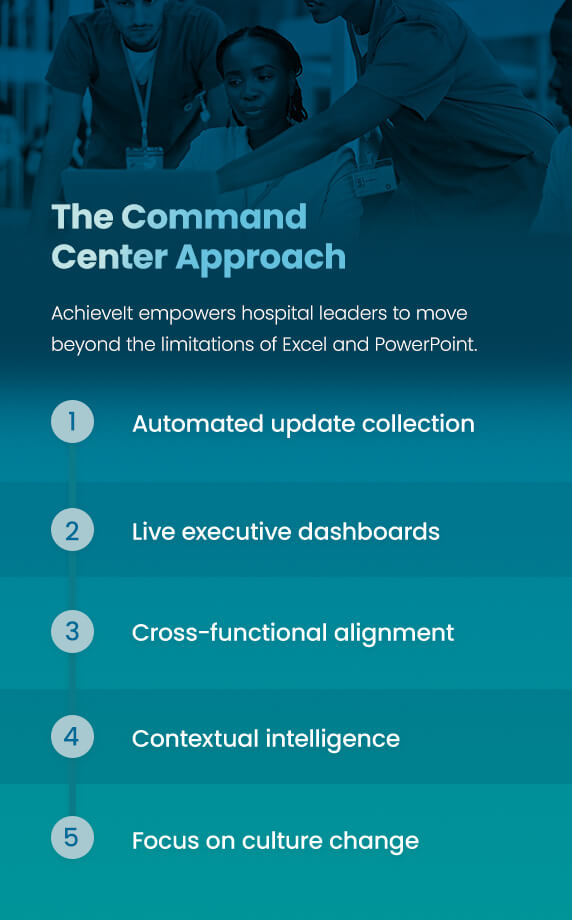
- Automated update collection: You no longer have to waste valuable management time chasing team members for status reports. The platform automatically prompts users for updates via email, compiling the results into a single view without manual intervention.
- Live executive dashboards: Detailed reports are useful, but leaders need at-a-glance visibility. AchieveIt provides real-time dashboards that visualize health using red-amber-green (RAG) status indicators, allowing executives to identify red items instantly and drill down into the root cause.
- Cross-functional alignment: Hospital initiatives rarely live in one department. AchieveIt allows you to link related items across different plans, connecting a nursing goal to an HR recruitment initiative. This connection keeps dependencies visible and breaks down silos.
- Contextual intelligence: Numbers alone do not tell the full story. The platform combines quantitative data with qualitative context, so leaders understand why a metric is trending up or down before making a decision.
- Standardized reporting: A uniform language is vital for success. Instead of every department defining progress differently, AchieveIt offers a standardized reporting cadence and format so data is comparable across the enterprise.
Real-World Application
Leading healthcare institutions utilize AchieveIt healthcare strategy solutions to manage complex, multi-year initiatives. Johns Hopkins All Children’s Hospital is a prime example. The hospital used the platform to revolutionize its strategic planning process.
Before AchieveIt, their team struggled with manual tracking that made it difficult to see the full picture of their strategic health. By adopting the platform, they moved from drowning in updates to a streamlined culture of transparency. The result was a clear, unified view of their strategic portfolio, where every initiative — from clinical improvements to operational upgrades — was visible, actionable and directly aligned with their mission of care.
From Planning to Results
Digital transformation is a journey, and you cannot navigate without a reliable map. Healthcare strategic planning software provides a map that is always current, accurate and accessible.
Implementing a platform like AchieveIt does more than digitize a document. It turns your strategic plan into a dynamic engine for change. Leaders are empowered to make decisions based on current reality rather than last month’s report. By linking high-level strategy to daily execution, hospitals can close the loop between planning to improve and actually seeing the results in their operational margins and patient outcomes.
Digital Innovation in Healthcare: Ready to AchieveIt?
The margin for error in healthcare has never been thinner. Rising costs, patient expectations and operational complexity demand a new approach to decision-making. The hospitals that thrive will be those that successfully bridge the gap between their data and decisions.
With the only platform purpose-built to drive integrated planning and strategy execution at your fingertips, there is no need to manage your multimillion-dollar digital transformation in static spreadsheets. You can stop chasing version four of a strategy deck via email or wondering if your team is aligned. It’s time to equip your organization with the tools to execute with precision.
Ready to see the difference? Take a self-guided product walk-through, or request your demo to discover how AchieveIt can centralize your hospital’s operational decision-making and turn your strategic vision into reality.