

Public health departments operate in an environment where chronic disease prevention, emergency preparedness, accreditation compliance, funding pressures and health equity initiatives all demand attention simultaneously. Reactive management amid such complexity costs more, achieves less and leaves communities underserved, which is why strategic planning has become essential rather than optional.
The pace of modern public health demands proactive approaches. Strategic planning transforms good intentions into measurable, accountable action by creating a framework where progress becomes visible rather than assumed.
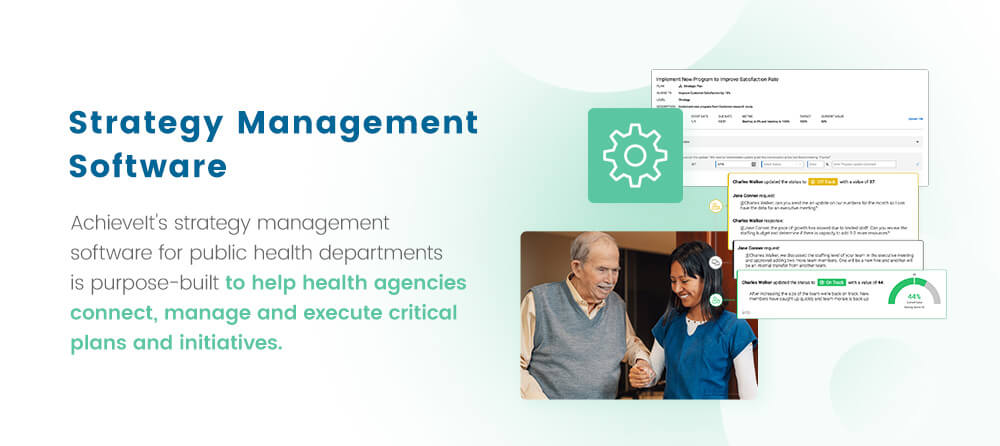
Strategic planning represents an investment in alignment and outcomes for public health professionals and the communities they serve. AchieveIt’s strategy management software for public health departments is purpose-built to help health agencies connect, manage and execute critical plans and initiatives.
In This Article
- What Is Strategic Planning in Public Health?
- Why Proactive Planning Improves Public Health Outcomes
- Strategic Planning and Compliance
- Elements of Effective Strategic Planning in Public Health
- Challenges and Solutions in Public Health Planning
- Real-World Examples of Strategic Planning Success
What Is Strategic Planning in Public Health?
Strategic planning in public health is the disciplined, agency-wide process of determining an organization’s direction and priorities, then charting a course to achieve them. Unlike day-to-day program management, strategic planning pushes health departments to look beyond crises toward long-term community health goals.
This process results in a roadmap for complex health environments, allowing them to allocate limited resources to meet population needs.
- Direction setting defines the vision, mission and values to guide the organization forward.
- Environmental scanning uses tools like SWOT analysis to examine internal strengths and weaknesses alongside external opportunities and threats.
- Resource allocation ensures staff and budget align with current priorities rather than historical patterns.
- Actionable objectives translate high-level goals into concrete, measurable actions that teams can execute.
- Monitoring and evaluation track progress to ensure effectiveness and accountability throughout the planning cycle.
The American Hospital Association has published a comprehensive toolkit that emphasizes developing comprehensive, multifaceted strategies to address community health needs. Association for Community Health Improvement recommendations create a balanced portfolio of mutually reinforcing interventions addressing short- and long-term outcomes and advocate for community-tailored strategies.
The National Association of County and City Health Officials offers a seven-module Local Health Department Strategic Planning Guide that covers every phase, from environmental scan to plan revision. Additionally, the Association of State and Territorial Health Officials provides a seven-phase Organizational Strategic Planning Guide designed as a cyclical process.
Strategic vs. Operational vs. Tactical Planning
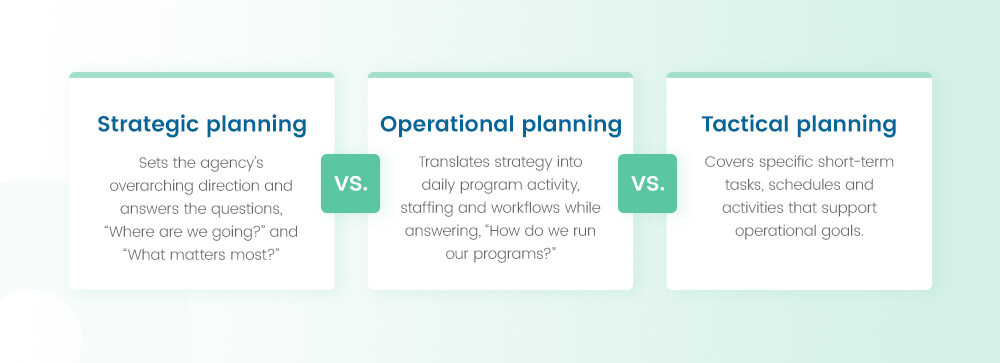
Teams often put in significant effort, yet without structured tracking, that activity doesn’t always translate into measurable community health gains. While strategic, operational and tactical planning serve distinct purposes, they work together to ensure all efforts have a distinct purpose.
- Strategic planning sets the agency’s overarching direction and answers the questions, “Where are we going?” and “What matters most?”
- Operational planning translates strategy into daily program activity, staffing and workflows while answering, “How do we run our programs?”
- Tactical planning covers specific short-term tasks, schedules and activities that support operational goals.
Why Proactive Planning Improves Public Health Outcomes
Proactive planning helps public health organizations anticipate and address health challenges more effectively. The benefits of public health planning extend to resource allocation and risk management, and measurably affect community engagement.
Anticipating and Addressing Health Challenges
Proactive strategic planning shifts public health from a reactive posture to one of foresight and resilience. Strategic planning uses macroenvironmental analysis to understand emerging trends — from shifting disease burdens and demographic changes to technological advancements and evolving federal funding landscapes.
Research analyzing 31 U.S. local health departments found that the typical priority areas embedded in strategic and community health improvement plans include:
- Behavioral health
- Chronic disease
- Social determinants of health
- Access to care
- Nutrition
- Physical activity
The identified priorities reflect a deliberate, data-driven approach to anticipating community needs instead of waiting for crises to demand attention.
The CDC’s community health assessment frameworks — including Mobilizing for Action Through Planning and Partnerships, developed by NACCHO with CDC partners — provide U.S. health departments with structured tools to identify threats and align resources before conditions deteriorate.
Smart Resource Allocation
Strategic plans align limited financial and human resources with the most critical population needs. Nationwide, local health departments operate with a median annual expenditure of $1.54 million, underscoring the need for disciplined resource allocation.
Scarce resources are the fundamental reason underlying the importance of strategic planning. Without strategic alignment, agencies risk investing in misaligned priorities or duplicating effort across programs. Effective plans connect resource decisions to measurable community health outcomes, directing dollars where they will have maximum impact.
Proactive Risk Management
Strategic planning enables health systems to optimize response efforts and maintain continuity of care during emergencies by proactively identifying operational and environmental risks. Risk management includes managing the “infodemic” — establishing communication protocols for common and emerging threats before crises demand improvisation.
Strategic plans that include environmental scanning — examining population health trends, workforce capacity, policy changes and funding shifts — give agencies early warning before risks become crises. ASTHO’s planning framework describes a cyclical process in which agencies continuously monitor, adapt and refine plans in response to evolving conditions.
Meaningful Community Engagement
Leveraging community-based assets and structures improves health literacy and risk perception, building the trust necessary for successful policy implementation and transforming the public from passive recipients into active stakeholders.
Broad engagement from frontline staff and governing boards to community members and partner organizations improves plan quality and increases the likelihood of successful implementation. When communities shape priorities, agencies gain credibility and residents become partners in achieving shared health goals.
Strategic Planning and Compliance
Effective public health leadership depends on more than good intentions. It requires structured, forward-thinking processes that keep organizations aligned, accountable and prepared.
Strategic planning bridges the gap between mission and execution, ensuring every initiative supports community health strategies and the regulatory standards that govern them.
PHAB Accreditation Requirements
Strategic planning creates a structured framework for oversight and accountability, transforming compliance from a passive exercise into a proactive managerial tool that improves service quality.
PHAB’s Standards and Measures require health departments to conduct, adopt and implement a formal strategic planning process. Effective plans establish key performance indicators that align daily operations with national standards.
Planning helps identify process inefficiencies, allowing organizations to streamline workflows to meet accreditation bodies’ rigorous safety and quality requirements. Living strategic plans facilitate regular audits and monitoring, remediating issues before they lead to regulatory violations. Accredited health departments signal to their communities, funders and partners that they meet a nationally recognized standard of quality and accountability.
Aligning Plans With Public Health Law and Funding
Aligning strategic plans with public health laws is critical for fulfilling legal mandates while pursuing broader health outcomes. Strategic plans must align with the CDC’s 10 Essential Public Health Services framework, state improvement plans and applicable federal mandates. Alignment ensures agencies fulfill core governmental public health functions while meeting accreditation standards.
Many federal grants require agencies to demonstrate strategic planning capacity as a condition of funding eligibility. Agencies with existing plans are in better positions to access and retain resources because they can demonstrate accountability structures and outcome measurement frameworks that funders demand.
Making Compliance a Strategic Driver
The COVID-19 pandemic identified a need to elevate strategic planning and management processes. A consolidated view of objectives, measures and initiatives breaks down silos and enables a culture of continuous improvement.
Public health compliance strategies work best when embedded into a living strategic management system instead of operating as separate reporting obligations. Compliance woven into daily operations through strategic planning becomes a driver of improved service delivery, stakeholder confidence and funding access.
Elements of Effective Strategic Planning in Public Health
An effective public health strategic plan is a living document that bridges the gap between high-level aspirations and measurable health outcomes. The core building blocks include vision and mission statements, goals and SMART objectives, performance measures, environmental scans, SWOT analysis and implementation plans.
A Vision and Mission
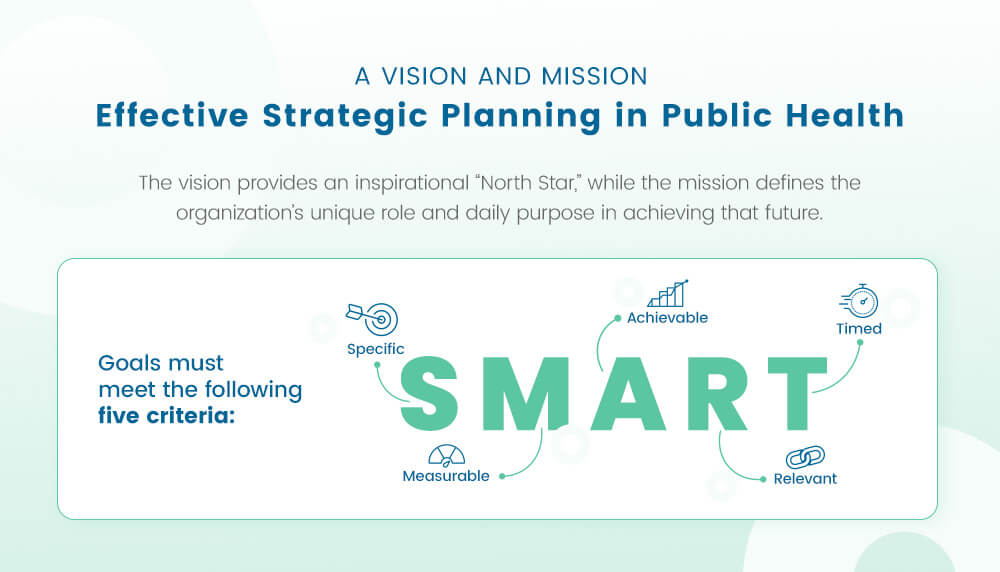
The vision provides an inspirational “North Star,” while the mission defines the organization’s unique role and daily purpose in achieving that future. Breaking down broad, long-term outcomes into the SMART framework makes them more realistically attainable. Goals must meet the following five criteria:
- Specific
- Measurable
- Achievable
- Relevant
- Time-bound
Performance measures using KPIs and logic models allow for real-time tracking. Effective plans move beyond tracking outputs, such as the number of vaccines administered, to measuring outcomes, such as reductions in disease incidence. Environmental scans and SWOT analysis provide a systematic review of internal strengths and weaknesses alongside external trends, threats and opportunities, grounding priority-setting in evidence rather than assumption.
The implementation plan assigns accountability, establishes a timeline, identifies resources and defines monitoring and revision protocols. Per PHAB, the implementation section is as critical as the planning because plans without execution mechanisms rarely drive meaningful change.
Stakeholder Involvement and Data-Driven Decisions
Strategic planning requires engaging diverse stakeholders to ensure the plan is culturally relevant and gains the necessary buy-in for implementation. Inclusive management spans community leaders, health providers, policymakers, frontline staff, governing entity representatives and the populations served.
PHAB and NACCHO require multilevel stakeholder participation as a formal component of the planning process. Best practices emphasize using Community Health Needs Assessments and epidemiological data to set priorities and direct resources to the most significant health disparities.
Best Practices From Leading Frameworks
NACCHO’s seven-module guide emphasizes that a strategic plan should align with the Community Health Assessment, Community Health Improvement Plan, quality improvement plan and operational work plans. Alignment across planning tools creates a cohesive system where strategic priorities drive daily work.
ASTHO recommends treating strategic planning as cyclical rather than a one-time event. Revisions will keep the plan documents relevant as needs evolve and new data emerges.
Challenges and Solutions in Public Health Planning
Even well-resourced organizations encounter friction during strategic planning. Potential barriers include the following.
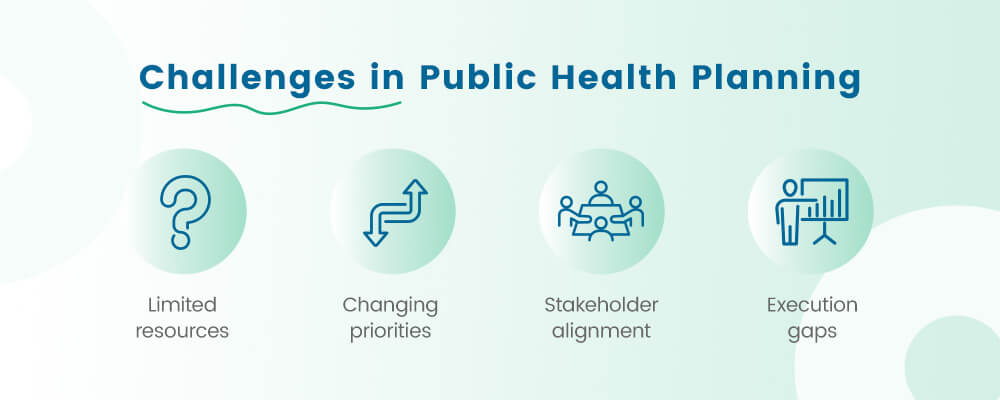
- Limited resources: Staffing shortages, constrained budgets and limited time for planning alongside daily program delivery create genuine constraints.
- Changing priorities: Public health is inherently dynamic. Disease outbreaks, policy shifts and funding changes can quickly make inflexible plans feel outdated.
- Stakeholder alignment: Achieving shared buy-in across governing bodies, community partners, frontline staff and leadership around common priorities is consistently challenging.
- Execution gaps: Many well-developed plans never result in meaningful progress.
Use these strategies to overcome obstacles.
- Phased planning timelines: Use phased planning timelines and leverage technical assistance from NACCHO and ASTHO to manage resource constraints.
- Living documents: Build plans as living documents with structured monitoring and revision cycles to prevent plans from becoming static reports.
- Structured engagement: Use structured stakeholder engagement sessions and transparent progress reporting to maintain alignment across diverse groups.
- Technology platforms: Adopt platforms like AchieveIt to integrate the strategic plan into daily workflows, automate accountability check-ins and provide leadership with real-time visibility into progress. Automation reduces the manual burden of update collection while improving data quality and response rates.
Real-World Examples of Strategic Planning Success
The most compelling evidence for strategic planning’s impact comes from organizations that have lived it. The following examples illustrate what is possible when modern tools and processes replace fragmented, reactive approaches.
Yamhill County Public Health
Serving residents across behavioral health, developmental disabilities and public health services, Yamhill County Health and Human Services relied on ad hoc check-ins, spreadsheets and shared documents. Quarterly state reports required pulling data from multiple disconnected sources, and managers lacked visibility into program progress between reporting periods.
After adopting AchieveIt, the department automated progress update requests and consolidated program and project tracking into a single platform. Results included substantially reduced reporting burden for state health department submissions, real-time status visibility across programs and a more data-driven approach. The team is now scaling the platform across Yamhill County Health and Human Services.
“Having the ability to progress quickly and easily has been huge for our team. We’re excited to have this new tool and look forward to implementing it across other teams in Yamhill County Health and Human Services for other project tracking and performance management needs,” said Bill Michielsen, MPH, CPH, public health division manager at Yamhill County.
Johns Hopkins All Children’s Hospital
A leader in pediatric health since 1926, Johns Hopkins All Children’s Hospital provides care across 50 specialties. Before AchieveIt, keeping all teams and facilities aligned with the institution-wide strategic plan was easier said than done. Strategic plan data scattered across spreadsheets, emails and presentation decks resulted in hours of manual work and inconsistent execution.
AchieveIt allowed the Johns Hopkins team to consolidate strategic plan data into standardized, always-ready dashboards. Automated reporting provided leadership with at-a-glance visibility into strategic plan progress.
Results included institutional alignment and a leadership shift from chasing updates to identifying what goals to tackle next. They also saw the successful completion of strategic initiatives, including the rollout of a new OB and maternal-fetal medicine program.
Agnesian HealthCare
Nonprofit integrated health system Agnesian HealthCare, part of SSM Health, operates hospitals, clinics, laboratories and pharmacies across Wisconsin. Before AchieveIt, monthly leadership meetings spent 90% of their time reviewing updates and only 10% taking corrective action.
After adopting AchieveIt, the system automated update collection and pre-meeting reports sent to leaders and executives ahead of each meeting. They saw a meeting focus flip, with sessions becoming 90% action and 10% update review, as well as increased engagement and participation across all facilities.
The entire SSM Health system adopted automated reporting beyond the ministry level. Teams that used to spend most of their time chasing updates can now devote more energy toward strategic initiatives.
Investing in Strategic Planning for a Healthier Community
Strategic planning is the discipline that turns public health vision into accountable, measurable action. Departments with strategic plans allocate resources more effectively, engage communities more authentically and demonstrate credible progress to funders and policymakers. Health departments that treat strategic planning as an ongoing practice will position themselves to meet today’s challenges and anticipate tomorrow’s.
AchieveIt’s Health Department solution matches the realities of public health work — from PHAB accreditation and multi-portfolio management to daily program execution and compliance reporting.
Request a demo to see how AchieveIt can help your agency connect strategies to outcomes. Take a self-guided product tour to see firsthand what strategic execution looks like, or contact our team to learn how AchieveIt can help your organization reach its full potential.