
Higher education institutions operate in complex enrollment environments impacted by shifting demographics and growing competition from alternative education providers. These conditions have turned enrollment into an institution-wide priority that hinges on coordination and sustained focus.
Improving enrollment outcomes requires a data-driven approach that connects insight to action across departments. With strategic planning and execution software, higher education institutions can maintain visibility into progress and refine efforts to sustain enrollment growth.
In This Article
- Understanding Enrollment Dynamics
- The Importance of Strategic Planning
- Enrollment Growth Strategies
- How AchieveIt Supports Enrollment Growth
- Case Study of How Belmont University Streamlined Enrollment Management Using AchieveIt
- Overcoming Common Enrollment Challenges
- Future Trends in Enrollment Management
Understanding Enrollment Dynamics
Various factors, including institutional positioning, impact enrollment outcomes. When organizations examine these dynamics holistically, they may notice patterns that help them plan and allocate resources effectively.
Factors that influence enrollment performance include:
- Demographic shifts and population trends: Changes in population and geographic concentration influence the traditional enrollment pipeline. Declining birth rates contribute to the enrollment cliff, reducing the pool of first-time, full-time students, while population growth has shifted toward new geographic and demographic segments.
- Competition from alternative education providers: The growth of online universities, certificate programs, bootcamps and employer-led education has expanded student choice. These alternatives appeal to learners seeking flexibility and alignment with the workforce.
- Economic pressures and tuition costs: Economic conditions influence enrollment intent and timing. Rising tuition and broader cost-of-living considerations impact how prospective students evaluate affordability.
- Student expectations: Prospective students expect career-readiness programs and support services. They look for courses that align with real-world outcomes and provide guidance throughout their academic journey.
The Importance of Strategic Planning
Given the complexity of enrollment dynamics, strategic planning can help guide insight and action. Here’s why having a strategic enrollment plan is important:
- Enables proactive adaptation: Strategic planning provides a framework for anticipating demographic shifts and preparing responses. Institutions can adjust recruitment strategies and plan program development with greater confidence by linking enrollment goals to population data and market analysis.
- Optimizes resource allocation: Enrollment efforts draw on resources across various departments. Strategic planning clarifies priorities so investments support initiatives with the greatest potential impact. This alignment helps ensure that resources contribute to enrollment goals.
- Fosters competitive differentiation: When planning is intentional, institutions gain clarity around what sets them apart. Strategic priorities help focus messaging and program development to reinforce institutional strengths.
- Ensures responsiveness to expectations: Strategic planning creates feedback loops that connect various insights back to decision-making. This structure allows institutions to refine offerings and support services as expectations evolve, keeping enrollment strategies aligned with student needs.
- Drives accountability: Clear goals establish ownership and measures of progress. Accountability ensures enrollment initiatives receive ongoing attention, supporting shared responsibility across teams.
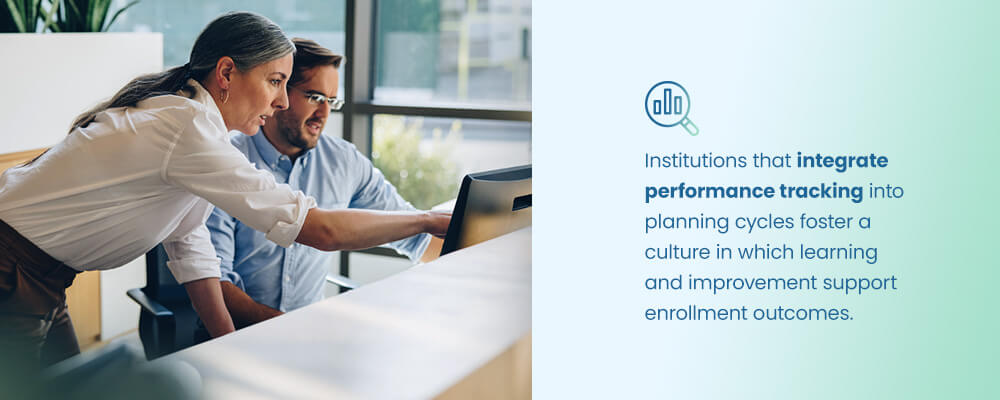
- Facilitates data-driven decisions: Data-based strategic planning for colleges and universities ensures regular evaluation of what works and where adjustments may improve results. Institutions that integrate performance tracking into planning cycles foster a culture in which learning and improvement support enrollment outcomes.
Enrollment Growth Strategies
Effective enrollment growth involves a set of strategies that address how students enroll and progress in your institution. Here are some approaches teams can implement.
1. Targeted Recruitment
One way to increase enrollment in graduate programs is to focus your resources on student populations most likely to enroll and succeed. Using demographic data, historical trends and program engagement analysis, institutions can identify segments where outreach will yield the highest engagement and conversion.
This approach also enables messaging to resonate with student motivations, whether that’s career outcomes or campus experience. Targeted recruitment can strengthen institutional yield and provide a foundation for adaptive strategies as market conditions shift.
2. Retention-Focused Initiatives
Retention-focused strategies ensure that enrolled students remain engaged and complete their programs. This approach may include:
- Addressing academic readiness
- Proactive advising
- Early alerts for at-risk students
- Fostering engagement through co-curricular activities
Institutions create continuity between recruitment promises and student experiences by connecting retention initiatives to enrollment goals. Measuring institution-specific metrics can help identify opportunities for intervention in the student life cycle.
3. Personalized Outreach
Another way institutions can increase enrollment in community colleges and universities is to use personalized outreach. This approach uses customer relationship management (CRM) systems and behavioral data to tailor messages and interactions for prospective students, allowing institutions to build meaningful connections that influence decision-making.
Personalization informs advising and ongoing communication. Consistency across touchpoints signals to students that your institution understands their goals and can meet their unique needs, thereby increasing conversion rates and reinforcing institutional credibility.
4. Program Diversification
Expanding and diversifying programs allows institutions to reach evolving student populations. Offering programs aligned with emerging job markets addresses demand across traditional and nontraditional segments, including adult learners and working professionals.
Program diversification also enhances institutional resilience. When offerings span in-person, online, hybrid and credential-focused programs, institutions can respond to enrollment fluctuations and changing workforce needs.
5. Financial Aid and Scholarships
Institutions can also increase student enrollment in universities and colleges by offering financial aid and scholarship programs that make access easier. Ideally, aid strategies should balance merit-based and need-based awards to align with market realities and enrollment priorities. This may help attract specific student segments.
Transparent communication about aid strengthens confidence in affordability. Students and families gain a clear understanding of how financial support complements academic and career goals, allowing cost considerations to reinforce value.
6. Data-Driven Decision-Making
Data-driven decision-making enables continuous refinement of efforts. By systematically tracking key metrics, institutions gain actionable insight into what drives enrollment success and where adjustments will have the greatest impact.
Key metrics may include:
- Inquiry to application ratio
- Application completion rate
- Offer acceptance rate
- Cost per enrollment
- Admissions processing speed
How AchieveIt Supports Enrollment Growth
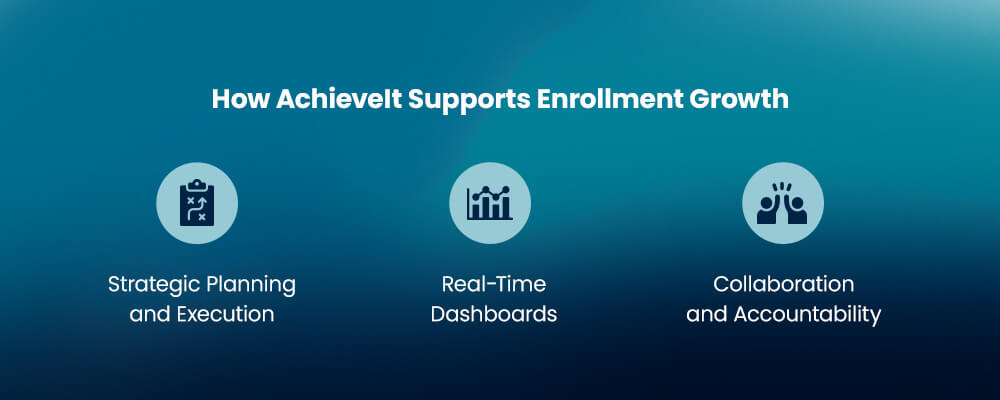
AchieveIt’s higher education strategy solutions let institutions turn priorities into visible, actionable goals across stakeholders, ensuring teams execute and measure initiatives effectively. Here’s how the solution supports enrollment growth.
Strategic Planning and Execution
AchieveIt turns enrollment goals into structured plans that define ownership and measurable outcomes. Departments gain a better understanding of who owns what and how each action contributes to broader enrollment targets. Plans remain flexible, so you can adjust tactics in real time as student behavior or market conditions evolve.
Real-Time Dashboards
AchieveIt’s dashboards provide instant insight into the status of initiatives and milestones. This means leaders can quickly identify high-performing initiatives and areas needing support. Visualizations can then align conversations around data-driven evidence, while continuous monitoring enables proactive adjustments.
Collaboration and Accountability
AchieveIt strengthens collaboration by creating a shared line of sight into goals and outcomes. This helps teams better understand how their work connects to institutional priorities while clarifying and reinforcing ownership through automated follow-ups. Regular updates and accountability keep leadership informed and allow teams to adjust priorities.
Scenario Planning
AchieveIt enables scenario planning, allowing you to model assumptions and evaluate the impact of strategic choices. You can:
- Test the effects of changing enrollment strategies
- Compare trade-offs across initiatives
- Prioritize actions with the greatest enrollment impact
- Adjust plans as market or demographic conditions shift
Case Study of How Belmont University Streamlined Enrollment Management Using AchieveIt
Belmont University, located in Nashville, Tennessee, is a dynamic institution known for its commitment to academic excellence, innovation and creativity. With a diverse student body and a strong emphasis on strategic growth, Belmont places high value on aligning institutional priorities with its mission to deliver a world-class educational experience.
Before adopting AchieveIt, Belmont relied on surveys, shared Word and Excel documents and ad hoc reporting to track strategic goals. While these methods offered documentation, they limited real-time visibility and consistent follow-up. The university typically set goals at the beginning of the academic year and reviewed them infrequently. This led to uneven progress tracking and reduced transparency across departments. Leaders found it challenging to understand how initiatives connected and where teams could offer support.
How AchieveIt Transformed Institutional Alignment
AchieveIt introduced a structured, data-informed approach to strategic execution. Teams were able to gain real-time visibility into priorities and create alignment between unit-level objectives and university-wide goals. Automated follow-ups, visual dashboards and standardized goal-setting made progress easier to track. As a result, Belmont strengthened strategic alignment and improved operational efficiency. Leaders also gained insight into shared initiatives and areas of overlap.
AchieveIt also helped foster a culture of accountability. Today, Belmont uses dashboards to support internal transparency and data-driven decision-making, with plans to expand visibility through public-facing dashboards.
Overcoming Common Enrollment Challenges
Enrollment challenges often persist because they stem from how institutions plan and execute work across complex environments. These obstacles can compound over time, influencing recruitment effectiveness, student experience and institutional confidence. Addressing them requires visibility into where friction occurs and a coordinated execution approach that supports efforts across the institution.
- Data silos across departments: Departments often distribute enrollment-related data across units, with each division operating its own systems and reporting cadence. This fragmentation limits shared understanding of how recruitment activity connects to student progression and outcomes, leading teams to make decisions based on partial performance views.
- Lack of accountability: Enrollment strategies typically span multiple teams and functions, and ownership dilutes when responsibilities are unclear. Initiatives may begin with strong intent yet lose traction and attention shifts, which can make progress hard to track.
- Slow response to market trends: Competitive offerings and economic conditions evolve continuously. Institutions that rely on periodic reviews often experience a lag between insight and action, limiting their ability to respond to opportunities.
- The enrollment cliff: Demographic change influences the composition and geographic distribution of prospective students. These shifts affect enrollment predictability.
- Rapid technological change: Technology impacts how students engage with education. Digital engagement and access to information influence expectations around convenience, transparency and support.
- Unclear value and ROI of a program: Students assess higher education based on outcomes, including career readiness. This perspective influences enrollment decisions across program selection and institution choice.
How AchieveIt Solutions Helps Overcome Enrollment Challenges
Here’s how AchieveIt’s solution helps institutions overcome enrollment challenges:
- Centralizes tracking of initiatives: AchieveIt centralizes enrollment-related initiatives and performance indicators in a shared environment, enabling teams to understand how individual efforts contribute to broader enrollment goals.
- Automates reporting to leadership: Automated updates provide timely visibility into progress, empowering leaders to make adjustments based on gathered information.
- Integrates workflows across departments: Clear ownership and structured follow-ups reinforce consistent engagement with enrollment priorities and support sustained execution across teams.
- Optimizes planning for demographic shifts: Planning tools support long-range thinking and help institutions align enrollment strategies with market dynamics.
- Articulates outcomes-driven value: By linking strategic goals to measurable results, institutions can demonstrate how academic offerings support student success.
Future Trends in Enrollment Management
Enrollment management continues to evolve as institutions respond to changing external conditions. Staying abreast of emerging trends can help stakeholders optimize their enrollment strategy for ongoing progress across the institution.
Here are some trends set to influence your enrollment strategy:
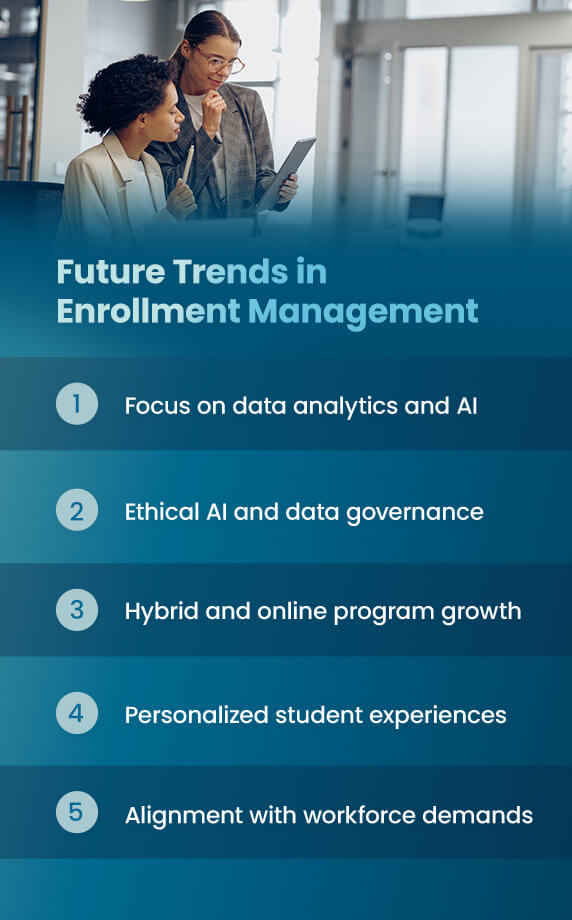
- Focus on data analytics and AI: Data analytics and artificial intelligence (AI) are influencing how institutions engage prospective students. Predictive modeling helps refine recruitment targeting, while analytics surface patterns in inquiry behavior and enrollment yield. These tools support informed outreach and resource allocation and help institutions focus attention where engagement potential is strongest.
- Ethical AI and data governance: As analytics and AI become embedded in enrollment operations, ethical use and data governance take on greater importance. Students expect institutions to manage their data responsibly and use technology to support transparency and fairness. Clear governance frameworks help ensure recruitment practices align with institutional values, while ethical use of data builds trust with prospective students.
- Hybrid and online program growth: Hybrid and online learning continue to appeal to students balancing education with personal or work obligations. Sustained growth in this area requires coordination across academic design, technology infrastructure, faculty support and marketing to help strengthen enrollment resilience.
- Personalized student experiences: From recruitment communications to academic advising and career support, students value experiences that reflect their goals and circumstances. Institutions that operationalize personalization across the student life cycle can meet anticipated needs.
- Alignment with workforce demands: Students seek programs that connect learning with relevant skills and career pathways. Strategic enrollment planning helps institutions assess labor market trends, evaluate program demand and guide academic investment.
AchieveIt’s Role
As enrollment management grows more interconnected, execution becomes a critical differentiator. AchieveIt can help you turn emerging trends into a coordinated strategic enrollment management plan with shared ownership and measurable progress:
- Orchestrate data-driven recruitment: AchieveIt helps you connect analytics insights to clearly defined initiatives, ensuring data informs action while governance and accountability remain embedded in execution.
- Supports hybrid and online program expansion: The platform supports coordinated growth by centralizing department-wide efforts within a single execution framework.
- Operationalizes personalized experiences: Clear ownership and progress tracking help personalization strategies become a consistent practice across teams.
- Dynamic student enrollment planning: Ongoing visibility into initiatives and outcomes allows you to adapt enrollment strategies as student needs and market conditions evolve.
Support Enrollment Growth in Higher Education With AchieveIt

Increasing enrollment in higher education requires a partner who understands the nuance of strategic planning and execution. AchieveIt works alongside higher education leaders to help them plan, implement and sustain enrollment initiatives with accountability and shared visibility.
Our strategic planning software allows you to align priorities across departments and track initiatives and outcomes. With automated follow-ups and data-driven insights, you can make more confident decisions.
Take a self-guided tour to experience firsthand what it’s like to execute your plans inside AchieveIt, or request a demo today to discover the benefits of a data-driven enrollment management plan.