
Improve Strategy Execution and Mission Outcomes
Across Federal, State, & Local Government, the importance of effective Performance Management continues to grow.
Since the creation of the Federal Performance Framework, the Office of Management and Budget (OMB) has worked closely with agency leaders to create an integrated and coordinated government-wide management approach to improve performance and deliver results.
In many cases, the processes to support these mission-critical plans and initiatives create significant challenges that impact results.
Government leaders are often challenged with:
- Communicating progress
- Maintaining alignment & uniformity
- Manual processes with poor accountability
- Limited visibility & siloed information
- Lengthy reporting cycles
We've written a quick guide that explains how other Government organizations have overcome these challenges to build a high-performance government.
Build a High-Performance Government: A Practical Guide
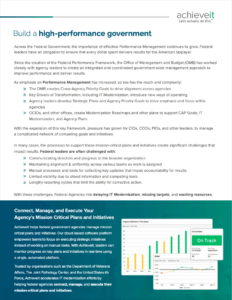
Across the Federal Government, the importance of effective Performance Management continues to grow. Federal leaders have an obligation to ensure that every dollar spent delivers results for the American taxpayer.
Since the creation of the Federal Performance Framework, the Office of Management and Budget (OMB) has worked closely with agency leaders to create an integrated and coordinated government-wide management approach to improve performance and deliver results.

As emphasis on Performance Management has increased, so too has the reach and complexity:
- The OMB creates Cross-Agency Priority Goals to drive alignment across agencies
- Key Drivers of Transformation, including IT Modernization, introduce new ways of operating
- Agency leaders develop Strategic Plans and Agency Priority Goals to drive emphasis and focus within agencies
- OCIOs, and other offices, create Modernization Roadmaps and other plans to support CAP Goals, IT Modernization, and Agency Plans
With the expansion of this key framework, pressure has grown for CIOs, COOs, PIOs, and other leaders, to manage a complicated network of competing goals and initiatives.
In many cases, the processes to support these mission-critical plans and initiatives create significant challenges that impact results. Federal leaders are often challenged with:
- Communicating direction and progress to the broader organization
- Maintaining alignment & uniformity across various teams as work is assigned
- Manual processes and tools for collecting key updates that impair accountability for results
- Limited visibility due to siloed information and competing tools
- Lengthy reporting cycles that limit the ability for corrective action.
With these challenges, Federal Agencies risk delaying IT Modernization, missing targets, and wasting resources.
Connect, Manage, and Execute Your Agency’s Mission-Critical Plans and Initiatives
AchieveIt helps federal government agencies manage mission-critical plans and initiatives. Our cloud-based software platform empowers teams to focus on executing strategic initiatives instead of working on manual tasks. With AchieveIt, leaders can monitor progress on key plans and initiatives in real time from a single, automated platform.
Trusted by organizations such as the Department of Veterans
Affairs, The Joint Pathology Center, and the United States Air
Force, AchieveIt accelerates IT modernization efforts by
helping federal agencies connect, manage, and execute their
mission-critical plans and initiatives.
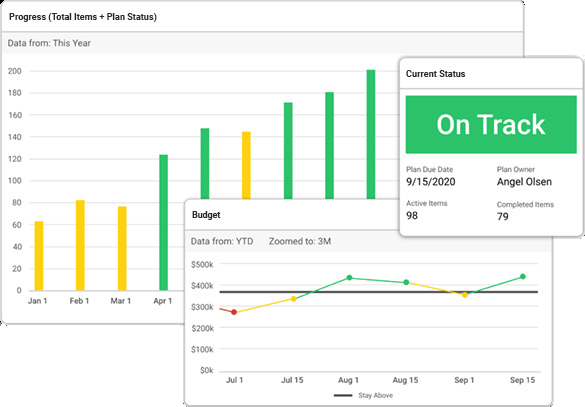
By using AchieveIt, regional medical centers within the VHA can greatly improve organizational performance in three key areas:
CONTRACT VEHICLES
CUSTOMER HIGHLIGHT
Veterans Health Administration
Regional Medical Centers
With more than 150 medical centers nationwide, it can be challenging for centers to gain the visibility needed to effectively track and manage service lines and strategic plans. Critical KPIs such as wait times, patient satisfaction ratings, medical services, and quality assessments are tracked and reported up to the Department of Veterans Affairs. These results determine a medical center’s overall rating and performance. But with strategic plans lacking alignment, structure, and centralization, it was nearly impossible to determine what factors were truly affecting a centers overall performance and how to monitor improvement of key initiatives.