

The foremost challenge for most health systems isn’t clinical capability — it’s coordination. Service lines operate with separate budgets, priorities and growth pressures, often lacking a unified strategic framework. The results are disappointingly predictable — competing goals, duplicated efforts and missed opportunities for systemic improvement.
Moving beyond static spreadsheets toward an integrated service line strategy changes that dynamic. An intentional shift toward coordinated care can align resources, streamline operations and support innovation across the entire organization.
This level of alignment depends on real‑time insight. Advanced planning platforms bring all service lines onto the same page, centralizing data and transforming isolated plans into a unified strategy that leaders can realistically execute.
Understanding Service Line Strategy in Healthcare
Service line strategic planning means proactively aligning clinical programs with market needs and organizational capacity. While operational management priorities revolve around staffing ratios, bed availability and daily scheduling, strategic planning asks where the service line will be in three to five years and builds the groundwork to get there.
The distinction between strategic and operational plans is crucial. A strategic plan sets the course for growth and market positioning, while an operational plan details the logistical steps that keep the organization running smoothly. Organizations that confuse the two often find themselves buried in busywork while failing to make progress toward their long-term goals.
In This Article
- Understanding Service Line Strategy in Healthcare
- Key Benefits of Effective Service Line Strategic Planning
- Overcoming Challenges in Service Line Strategic Planning
- Future Trends in Healthcare Service Line Strategy
- How Technology Enables Service Line Planning
Core Components of a Service Line Strategy
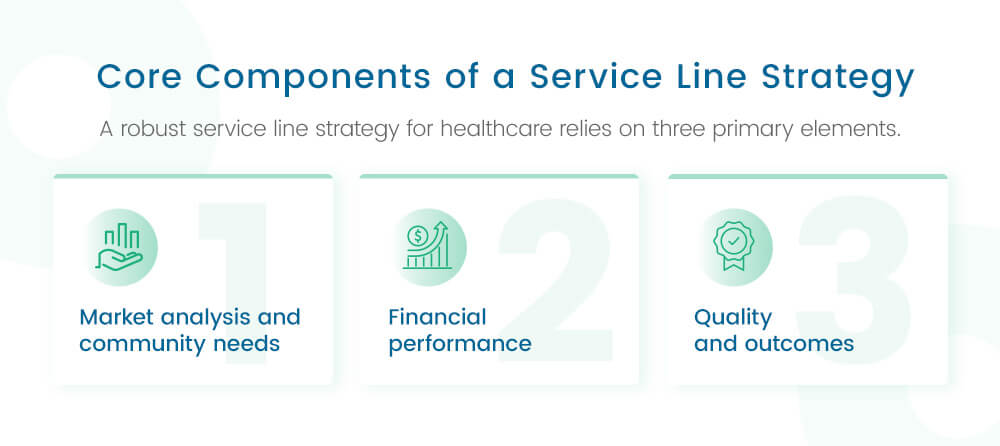
A robust service line strategy for healthcare relies on three primary elements.
- Market analysis and community needs: You must understand the specific disease burden of the population you serve. For example, recent data on chronic disease prevalence in the U.S. highlights significant geographic variations in conditions like diabetes and heart disease. A hospital in a ZIP code with a high prevalence of cardiovascular disease must dedicate more resources to cardiology capacity, compared to a facility in an area with a younger demographic. Using this data allows leaders to match service line capabilities to local demand.
- Financial performance: Successful planning requires a thorough examination of contribution margins. Some high-volume service lines have low margins. Others are lower volume but drive significant profitability that subsidizes other essential services. Understanding this mix is vital for sustainable growth.
- Quality and outcomes: Clinical key performance indicators should link directly to the strategic plan. Readmission rates, patient safety metrics and infection rates are compliance issues and competitive differentiators. A strategic plan must include specific initiatives to improve these outcomes over time.
The Challenge of Interconnectedness
The ultimate goal of service line strategic planning in healthcare organizations is to achieve a state where individual departmental goals align with the broader health system strategy. Unfortunately, this is easier said than done. By securing the funds for new imaging equipment, the orthopedics department might drain resources the neurology team needs. In organizations that lack a centralized view, these conflicts often remain unnoticed until the end of the budget cycle.
An integrated, holistic approach requires a planning process that makes these trade-offs visible from the outset. It ensures that every decision supports the enterprise’s mission, rather than the ambitions or influence of a single, powerful department.
Key Benefits of Effective Service Line Strategic Planning
When hospital service line organization is effective, the benefits extend beyond the boardroom. They impact patient health and clinicians’ daily lives.
Healthcare Operational Efficiency
Strategic planning highlights redundancies that tend to fly under the radar in day-to-day operations. For example, a health system might discover that its oncology and infusion centers use completely separate scheduling software, despite serving the same patients. The organization can reduce administrative overhead and improve the patient experience by consolidating these functions.
Efficiency also comes from better capacity management. When service line leaders accurately forecast demand, they can staff appropriately, which reduces reliance on expensive outsourcing and prevents burnout during peak periods.
Financial Precision
Well-executed hospital service line management allows for accurate budgeting. Instead of applying a flat-rate budget increase or cut across all departments, leadership can invest strategically to achieve optimal results. For instance, data might reveal that the neurosciences service line is a primary growth engine with high contribution margins. The organization can then invest more heavily in this area while maintaining consistent budgets for stable, mature service lines.
This precision is essential in an environment of shrinking reimbursements. Hospitals can no longer afford to guess where their profitability comes from. They need to know which services drive the bottom line so they can nurture and grow them.
Improved Patient Outcomes
There’s a direct link between strategic planning and better care delivery. Departmental friction can become a thing of the past when teams design patient pathways together. Picture patients moving seamlessly between the emergency department and the hematology lab because shared processes guide every step.
Clearer pathways shorten wait times and reduce leakage — the moment a patient goes elsewhere for follow‑up care because they felt the internal referral process was too complex. When patients stay within the system, clinicians maintain a complete care record, and outcomes typically improve.
Strategic Alignment
Strategic alignment, also known as the “golden thread,” is a simple framework that ties an organization’s goals to its everyday actions. In an aligned health system, a nurse manager or department administrator can readily see the connection between their job and their employer’s five-year objectives.
Employee engagement increases when they understand how their work contributes to overarching success. A department director is no longer just balancing a budget. They are executing a crucial part of the enterprise strategy. This sense of purpose is the most profound benefit of service line integration because it drives organization-wide performance and accountability.
Overcoming Challenges in Service Line Strategic Planning
Transitioning to a hospital service line management structure can create hurdles. Organizations often face significant resistance.
- Data silos: Many hospitals operate with a patchwork of software systems, leaving leaders flying blind. The electronic medical record holds clinical data, while enterprise resource planning captures financial data and HR systems maintain staffing data. Integrating these disparate systems to communicate with each other is a significant technical challenge.
- Cultural resistance: Change can be disorienting. Department heads accustomed to autonomy may fear losing control in a centralized service line model, while physicians may resist standardization if they feel it impinges on their clinical judgment.
- Misaligned incentives: Strategies often fail when models and goals do not match. For instance, the strategy will struggle to gain traction if a service line goal is to reduce readmissions, but physicians get paid purely on volume.
- Failure rates of change initiatives: In most cases, leading people to accept change starts with a complete and clearly defined strategy. Organizations that rely on manual processes and disjointed communication are likely to struggle with their strategic transformation.
Strategies for Success
Organizations can implement focused, coordinated efforts to overcome barriers and improve their success rate.
- Democratize data access: Give service line leaders access to their departmental performance data. When a director can see metrics in real time via a platform, they can stay the course or self-correct. They don’t need to wait for a quarterly report to know if they are exceeding expectations or falling behind.
- Standardize governance: Create a uniform template for strategic initiatives. Every service line should report progress in the same language and format, allowing executives to make apples-to-apples comparisons across the organization.
- Secure executive buy-in: A service line model requires a champion at the C-level. A chief strategy officer or COO must drive the initiative and mediate conflicts that arise.
- Build accountability through visibility: When every initiative’s status is visible on a dashboard, it creates a culture of accountability. High performers receive well-earned recognition for their success, and those who are struggling receive the support they need to get back on track.
Future Trends in Healthcare Service Line Strategy
The quest for improved healthcare operational efficiency and patient care is in a constant state of flux. Leaders must look ahead to stay competitive.
Data-Driven Decision-Making
The future belongs to those who can accurately anticipate demand as the world moves toward predictive analytics and AI. Instead of looking at last year’s flu season to plan for this year, hospitals will use real-time data to forecast patient surges. This informed intuition allows health providers to allocate staff and equipment to where they can do the most good before demand becomes critical.
Patient-Centric Planning
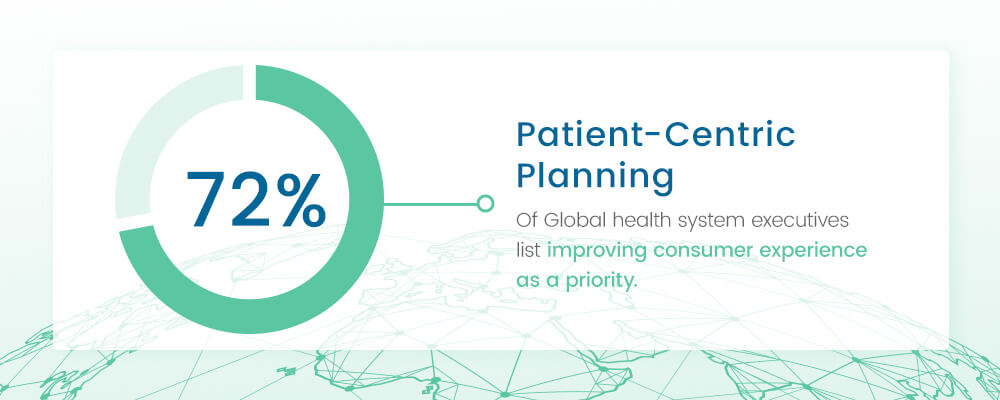
Historically, service lines in healthcare organizations revolved around medical departments. The future is reorganizing them around patients, since 72% of global health system executives list improving consumer experience as a priority.
This impetus now drives patient-centric strategic planning and the subsequent creation of condition-based institutes. For example, a hospital with separate neurology, neurosurgery, orthopedics and rehabilitation departments might choose to consolidate them under one roof by building a new brain and spine center. This structure creates better patient experiences instead of catering primarily to internal dynamics.
Continuous Planning
Today, the market moves too fast for an annual strategic plan to remain sufficient. Leading organizations have transitioned to continuous planning cycles, where they review and update their strategies quarterly or monthly.
Service line planning software enables this agility. Leaders can pivot quickly using live, real-time data. If a competitor opens a new ambulatory surgery center nearby, executives have all the facts they need to respond tactically.
How Technology Enables Service Line Planning
The traditional approach to planning relies on static information. Leaders spend weeks building PowerPoints and spreadsheets, present them once, then file them away until the next planning cycle — if they revisit them at all. That outdated model no longer keeps pace with operational needs in healthcare environments where patient demand, reimbursement pressures and workforce dynamics shift weekly or daily.
The Failure of Spreadsheets
Spreadsheets are notoriously prone to version‑control issues, making them inadequate for modern strategic planning. When someone updates a metric in a local file, that change rarely makes its way back to the system‑wide plan, leaving teams to make decisions based on outdated or incomplete information.
Spreadsheets also offer no built‑in accountability. They can’t send reminders, flag missed deadlines or alert leaders when performance starts slipping. The result is a reactive management culture where problems come to light only after they’ve already affected performance.
Service Line Planning Software Solutions
Specialized strategic planning software for hospitals lets them transition into a proactive management style. Investing in strategy execution technology is mission-critical, considering its far-reaching influence on success.
- Centralized dashboards: A unified dashboard gives the C‑suite a single source of truth, making it easy to compare performance across all service lines. This level of visibility highlights cross‑functional trends, shows over‑ and under‑used resources and keeps every service line aligned with system‑wide priorities.
- Real-time KPIs: Automated data feeds track volume, revenue and quality metrics without manual data entry, thus eliminating the lag time between actual performance and reporting. Leaders can immediately spot a dip in patient volume or a rise in costs, allowing for course correction in days rather than waiting for end-of-month reports.
- Scenario planning: Tools that encourage leaders to ask “What if?” questions are vital for risk management. For example, “What if we expand cath lab capacity by 20%?” Service line software helps executives anticipate downstream effects on staffing and bed availability, preventing operational bottlenecks before they occur.
- Clear ownership: Ambiguity causes many cross-functional projects to stall. The ability to assign specific initiatives ensures everyone knows who is responsible for each outcome. Attaching names to results makes accountability a natural part of the workflow.
AchieveIt’s Integrated Plan Management
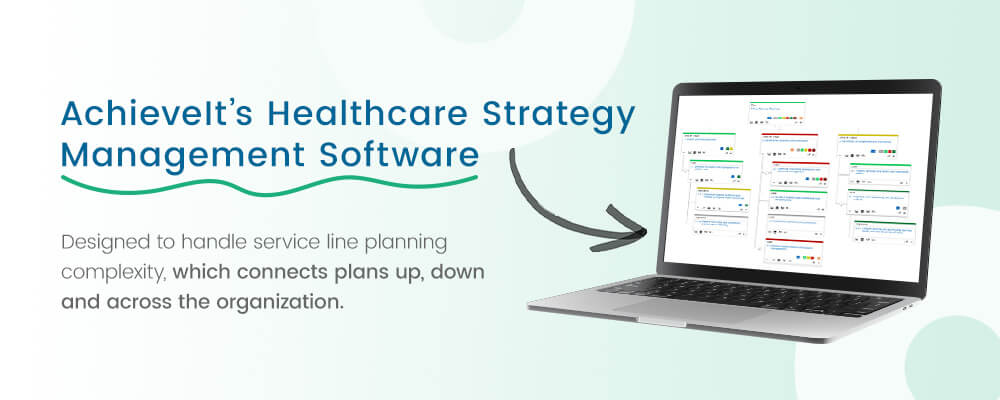
AchieveIt offers healthcare strategy management software designed to handle service line planning complexity, which connects plans up, down and across the organization.
With AchieveIt, service line leaders don’t need to spend days preparing to complete a monthly review. Instead, they can consult real-time data on a user-friendly dashboard. Then, they can return their focus to strategic decision-making instead of chasing down information about which initiatives are on track and which are at risk. This visibility naturally drives performance by making accountability part of the culture.
Mastering the Future of Service Line Success
Service line strategic planning is the bridge between clinical excellence and organizational sustainability. It turns disjointed departments into a unified, high-performing system. Health systems can improve efficiency, financial health and patient outcomes by breaking down barriers and aligning goals.
You can continue to struggle with organizational silos, outdated spreadsheets and misaligned goals — or you can adopt a modern approach. Adopt technology to centralize execution and provide the visibility you need to lead effectively.
If you are ready to stop managing disparate plans and start orchestrating a unified strategy, it’s time to invest in tools that make it possible. Request a demo of AchieveIt today to see how centralized planning can redefine your service line operations and position you for growth.