
Most strategic plans are written as if the people who wrote them will be around to see them through. Some will. Many won’t.
A manager takes a job in another state. A council member loses in November. A director who has tracked the plan from memory for years retires. The plan is still on the shared drive. What’s gone is the person who knew which projects were slipping, and why.
How often does that happen? Often enough to plan for. Since 2020, 129 of the 238 Georgia cities with a city manager have changed managers at least once, according to the Georgia Municipal Association. Elections are part of the pattern. After one round of May council elections in Texas, 16 city managers were out of their jobs, about 3% of the state’s managers, according to a 2009 analysis in ICMA’s Public Management magazine. In ICMA’s 2018 form of government survey, most council members served four-year terms and about 1 in 5 served two, so a plan built to last longer than that will likely cross at least one election before it’s done.
We’ve covered the performance-measure side of that in our guide to keeping momentum through an election. The gap that’s left is the people and information that walk out the door.
In This Article
- Who sets policy, and why your form of government matters
- What breaks when leadership changes
- How to keep a strategic plan moving through leadership changes
- What to look for in tools that keep the plan moving
- What it looks like in practice
Who Sets Policy, and Why Your Form of Government Matters
Policy in local government runs through three groups. Elected officials (the council, board of supervisors, or mayor) set direction by adopting ordinances, approving budgets, and voting on strategic priorities. A city manager or mayor turns that direction into budgets, timelines, and work plans. Department heads and staff in public works, finance, planning, and parks carry it out day to day, and they’re usually the ones reporting progress by hand.
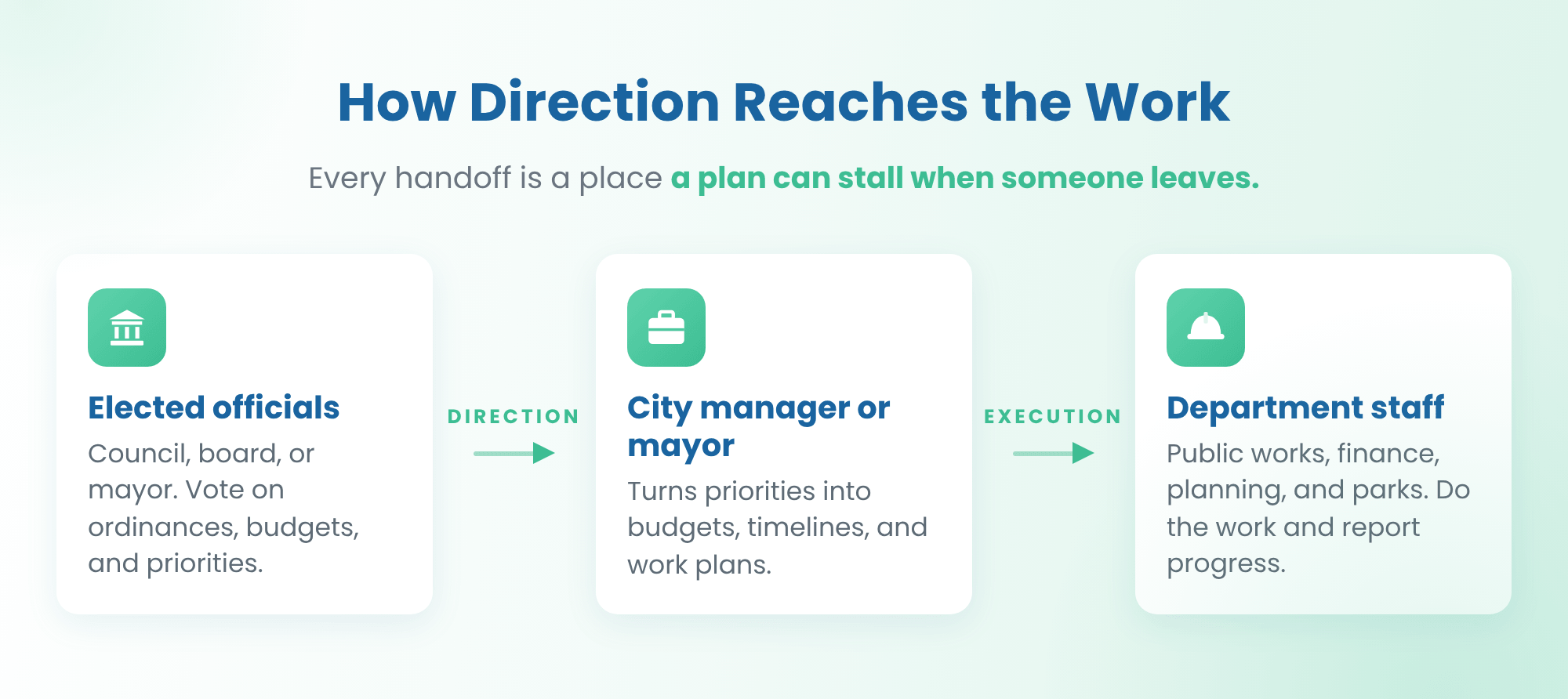
The middle layer is where cities differ, and it decides how quickly an election reaches your plan.
- Council-manager: The council appoints a professional manager and can replace them by vote at any time. One election changes direction first, and often the manager soon after. It’s the most common form, used by 48% of cities in the ICMA survey, including Phoenix, San Antonio, and Dallas.
- Mayor-council: An independently elected mayor runs day-to-day operations and answers to voters at the ballot box, so one election can change direction and delivery at the same time. It’s second at 38% and more common in the largest cities and in towns under 5,000, including New York, Houston, and Chicago.
Neither structure is safer. The risk lands in a different place, which is worth knowing before you decide where to put your safeguards.
The basics of a good plan don’t change with the structure. If you’re still building yours, start with how to create a strategic plan for a government department. What follows is about keeping it alive once it exists.
What Breaks When Leadership Changes
An election doesn’t stop a city’s work. Roads are still being repaired, grants still have deadlines, and departments are still delivering services. But new leaders may have trouble seeing how that work connects to the priorities they’ve inherited.
Say the city approved a Main Street corridor project to support its street safety goal. Public Works owns the project, and part of its funding comes from a grant. The goal and the project are both in the strategic plan. What might be missing is the information someone needs to decide what happens next.
For a New Council
The risk is revisiting a priority without seeing the commitments behind it. Why was Main Street chosen? What funding has been approved? What would changing course affect? Council members should be able to set a new direction with those answers in front of them.
For a New City Manager
The risk is a decision getting stuck. The project is marked “at risk,” but the update doesn’t say whether Public Works needs a scope decision, more funding, or help meeting the grant deadline. The manager has to track down the issue before anyone can fix it, and the grant deadline doesn’t move because the manager did.
For a New Department Head
The risk is losing ownership of the next step. If the previous director was the only person requesting updates or tracking a milestone, the work may continue while the plan goes stale. Leadership may not see the problem until much later.
The plan hasn’t disappeared. What’s missing is a clear view of what the city committed to, where the work stands, and what decision comes next. Plans rarely get formally abandoned. They get quietly orphaned, because keeping them current was one person’s habit and nobody else’s job.
How to Keep a Strategic Plan Moving Through Leadership Changes
None of this takes a heroic effort. Most of it comes down to making sure the plan’s memory lives somewhere other than inside a person.
- Give every priority one named owner: A priority with no owner is the first to go quiet when someone leaves, because nobody is on the hook to keep it current. Name a person, not a department, and name a backup.
- Tie priorities to the budget: A priority backed by approved dollars is much harder to drop quietly than a line on a values slide. It also gives a new council something concrete to weigh before changing course.
- Record why, not just where things stand: A percent-complete bar can’t tell a new leader why Main Street was chosen over another corridor. Capture the decision and what was weighed. Some departments hesitate to write that down because they worry it will be used against them later. That’s understandable, and it’s also what leaves the next leader guessing. Keep the language neutral and treat the record as the plan’s memory, not a ledger of blame.
- Hand off commitments as data, not as a conversation: When a manager or director leaves, their open commitments and next milestones should move to a named person through a set step. A verbal briefing might happen before their last day. It might not.
- Put turnover on the calendar: Track election dates, expected retirements, and roles with a history of short tenure. Plans tend to assume today’s leadership will see them through, and that assumption fails sooner than most teams expect. A vacancy or an approaching election is the cue to shore up documentation beforehand, not after.
What to Look for in Tools That Keep the Plan Moving
Spreadsheets, shared drives, and email can hold a plan together for a while, as long as the person maintaining them stays. That dependence is exactly what turnover exposes. If you’re evaluating software, these are the capabilities that matter for continuity.
- One system of record: Priorities, owners, budgets, and status in the same place, not scattered across department spreadsheets and inboxes. That’s what lets the plan’s current state outlive any one person’s files.
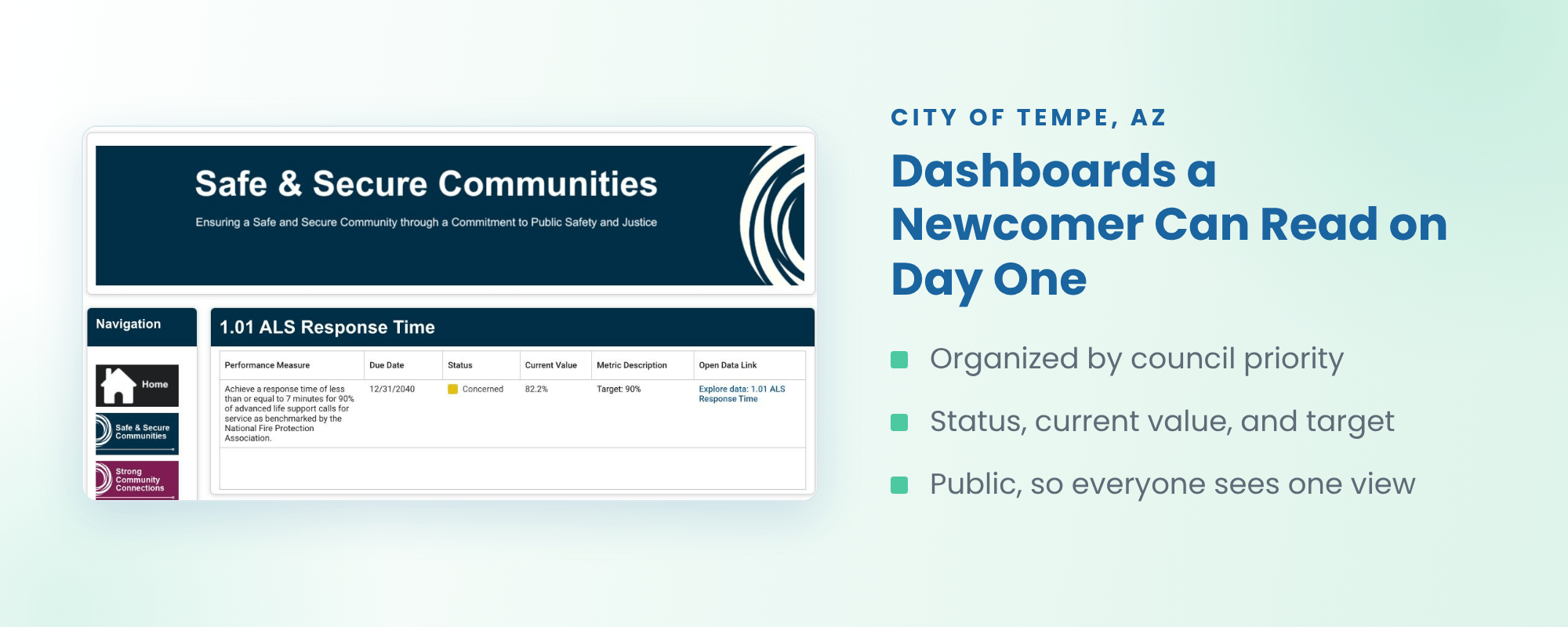
- Dashboards a newcomer can read on day one: A new council member or manager should be able to see status, owner, and last update without waiting for a briefing. The same goes for performance data, so it helps to know the measures worth putting on that dashboard. The City of Tempe, Arizona, organizes its public dashboards by council priority, which is what a newly seated council member needs to see.
- Automated update requests: Chasing status by email works until the person doing the chasing leaves. Requests tied to named owners keep going without them.
- A decision log or audit trail: It captures the reasoning behind a priority alongside its current status, so a new leader can see how a project got where it is, along with its current number.
One warning: software alone won’t fix this. Staff who have tracked progress their own way for years won’t switch because leadership asked them to. Updates have to be requested through the system, or people will keep sending them by email.
What It Looks Like in Practice
The City of Pittsburg, California, has more than 76,000 residents and the problem described above. Goals lived in Smartsheet, ownership of many performance measures was unclear, and department directors spent much of their time answering questions about goal status. With AchieveIt, updating a goal takes a few minutes, and the updates feed public dashboards on the city’s website. Council members say the feedback link on each dashboard page helps them answer constituent questions, and the city has shared them in council meetings and the Mayor’s State of the City address. When status is public and current, a newly elected council member starts with the same view as everyone else.
Citrus County, Florida, with about 160,000 residents, set out to improve transparency. The county also credits the shared system with continuity through periods of high turnover: less reliance on individual memory and old records, and new team members who get up to speed without extensive onboarding. That story is about staff turnover rather than elections, and the mechanism is the same. When the plan’s status lives in the system, the next person can pick it up.
Keep Your Strategic Plan Moving with AchieveIt
If your city manager left next month, could the person stepping in see where every priority stands by the end of their first week?
AchieveIt gives cities, counties, and special districts one place for strategic plans, budgets, and performance data. Decisions, rationale, and current status live in the system instead of in someone’s inbox, so when an election or a retirement comes, the next person starts from where the plan is. Take the 3-minute product tour to see how it works for a city or county.