
State agencies often manage dozens of simultaneous programs across multiple departments, all under intense public and legislative scrutiny. That complexity demands program accountability — the ongoing practice of tracking whether government programs meet their goals, spend taxpayer money wisely and deliver measurable results for the people they serve.
Citizens and public officials expect transparency and proof of effective state government program management. Agencies that fail to provide this clarity risk losing credibility, funding, trust and public support. Fortunately, building dynamic accountability systems is achievable with specific strategies and tools.
In This Article
- Fundamentals of Reporting and Program Tracking in Government
- Strategies to Enhance Program Accountability
- Overcoming Challenges in Program Accountability
- Real-World Examples of Improved Accountability
- Build Trust Through Transparent Program Management
Fundamentals of Reporting and Program Tracking in Government
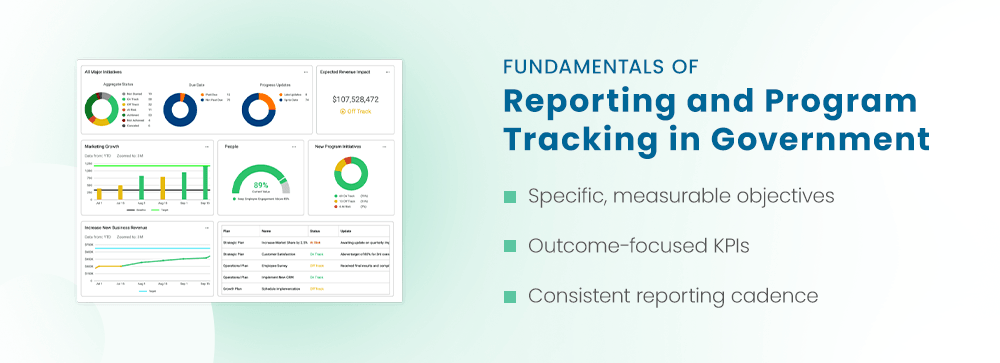
Every tracking and public sector program reporting system needs three core elements working together.
- Specific, measurable objectives: Everyone needs a shared definition of success to work toward the same goals. Accountability is much harder to measure when objectives are vague or disconnected from your agency’s mission.
- Outcome-focused KPIs: Key performance indicators should answer “How do we know it’s working?” instead of merely confirming you did the work. Tracking “reduced 311 response time by 20%” proves accountability in a way that “held 12 community meetings” never will because only one of those measures concrete results.
- Consistent reporting cadence: Accurate and timely reporting converts raw tracking data into accountability. Manually compiled reports that draw on scattered sources are often outdated by the time leadership sees them, which defeats the purpose.
Knowing what resources are available isn’t the problem — 49 states and Washington, D.C., maintain inventories of state-funded programs. The challenge lies in tracking real-time execution across that inventory. That execution gap is where legislative oversight tends to focus and where agencies without modern, real-time tracking tools struggle to keep up.
Strategies to Enhance Program Accountability
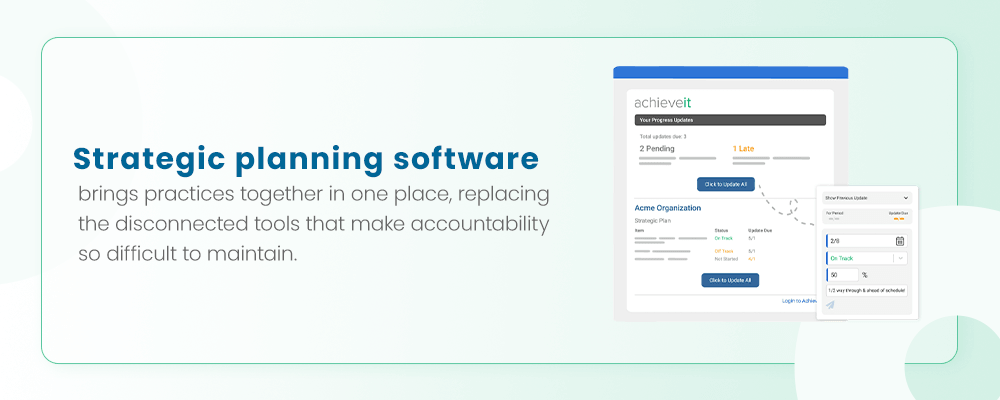
If your agency still pieces together program data from a hodgepodge of spreadsheets, email chains and multiple siloed platforms, you know how inefficient, time-consuming and error-prone this task is. Strategic planning software brings five practices together in one place, replacing the disconnected tools that make accountability so difficult to maintain.
- Assign ownership: Every initiative needs one named person responsible for progress and reporting. Systematize this by documenting who owns which programs and what success looks like.
- Build a regular review schedule: Monthly or quarterly check-ins catch initiative drift before it becomes a missed legislative deadline. Embed accountability into the meeting rhythm instead of saving it for the annual review.
- Proactively engage stakeholders: Agencies that build reporting channels for legislators, oversight bodies and the public create external accountability that reinforces internal discipline while reducing reactive and ad hoc reporting requests. States increasingly back funding decisions with performance evidence, which makes proactive stakeholder engagement essential.
- Shift to data-driven decision-making: When leaders have real-time performance data, they can reallocate resources, fix bottlenecks and course-correct instead of explaining failures after a legislator calls. Research shows that 95% of leaders say plan completion improves when accountability and ownership are clear.
- Centralize tracking into one platform: Operational and strategic needs converge in a single system where all initiatives live, updates flow automatically and dashboards are always current. While 77% of senior leaders cite department silos as a barrier to executing strategic initiatives, a centralized platform breaks down those walls, reduces reporting time and gives everyone access to the same real-time information. It also creates a continuous audit trail, dramatically speeding compliance reviews and legislative oversight compared to reconstructing accountability after the fact from scattered documentation.
Overcoming Challenges in Program Accountability
While 46 states now collect performance data in some form, most agencies still struggle to use the information they gather. You can close that gap by maintaining a consistent record of what your team did and how well it worked.
Even after implementing these specific tools, agencies experience roadblocks that can derail their accountability efforts.
- Fragmented data: When program data lives across multiple spreadsheets and platforms, nobody has a complete picture of what’s going on.
- Unclear ownership: Initiatives quickly fall through the cracks without designated authority.
- Resource constraints: Manual, time-consuming reporting processes pull staff away from program delivery, creating a cycle in which tracking work competes with the mission.
- Technology adoption concerns: Many agencies assume that modernizing means replacing everything they already use, but the most effective platforms integrate with existing systems and minimize disruption.
Real-World Examples of Improved Accountability
See some government accountability best practices in action across these case studies from real agencies.
The Oklahoma State Department of Health managed over 30 strategic portfolios using a labor-intensive manual process built on Microsoft products. After centralizing onto a single platform, they gained real-time updates and automated task management across all portfolios, replacing a process that previously required significant manual overhead.
Florida Court Clerks & Comptrollers experienced a different challenge. Their strategic plan lived in a 100-plus-page Word document with version control issues and siloed teams across locations. Moving to a centralized platform replaced manual processes with automated updates and dashboards, giving leaders across all functional areas easy access to real-time progress. It directly improved decision-making and enabled the organization to exceed its strategic goals.
Build Trust Through Transparent Program Management
Program accountability is the foundation of public trust and effective governance. Ownership, consistent reporting, centralized tracking and data-driven decisions can transform how your agency operates.
Agencies that build robust accountability systems earn the confidence of legislators, auditors and citizens while creating the infrastructure that lets their teams execute. Request a demo or take a live product tour to see how AchieveIt helps agencies like yours align strategy, track execution and demonstrate responsibility to leadership and the public.