
It’s the November board meeting. The superintendent walks trustees through the district’s annual plan update, the one that went to the state last spring. It runs dozens of pages. Then a trustee asks a simple question: are we on track for third-grade reading this year? Nobody can answer from what’s in the packet, and someone promises to follow up.
Most districts don’t lack a plan. Many are juggling several: the plan the state requires, the plan tied to federal Title I money, the strategic plan the board adopted with the community, and an improvement plan at every school. What’s usually missing is a short list of measures the board reviews on a set calendar, connected to the work happening in classrooms.
So, are school districts required to have a strategic plan? In most states, some version of one, yes. Meeting that requirement is the easy part. It won’t tell your board whether students are better off than they were in August. This year, with chronic absenteeism still well above pre-pandemic levels and enrollment shrinking in many districts, boards can’t wait for next fall’s state results to find out.
In This Article
- Are school districts required to have a strategic plan?
- What boards should track in 2026–27
- How to connect the district strategic plan to classroom work
- What it looks like in practice
- Frequently asked questions
Are School Districts Required to Have a Strategic Plan?
What Federal Law Requires of a School District
No federal law requires a district to adopt a document called a strategic plan. There is a funding condition, though. Under the Every Student Succeeds Act, a district can receive Title I money only if it keeps a state-approved plan on file, developed with teachers, principals, and parents and revised as needed.
Which States Require a District Strategic Plan
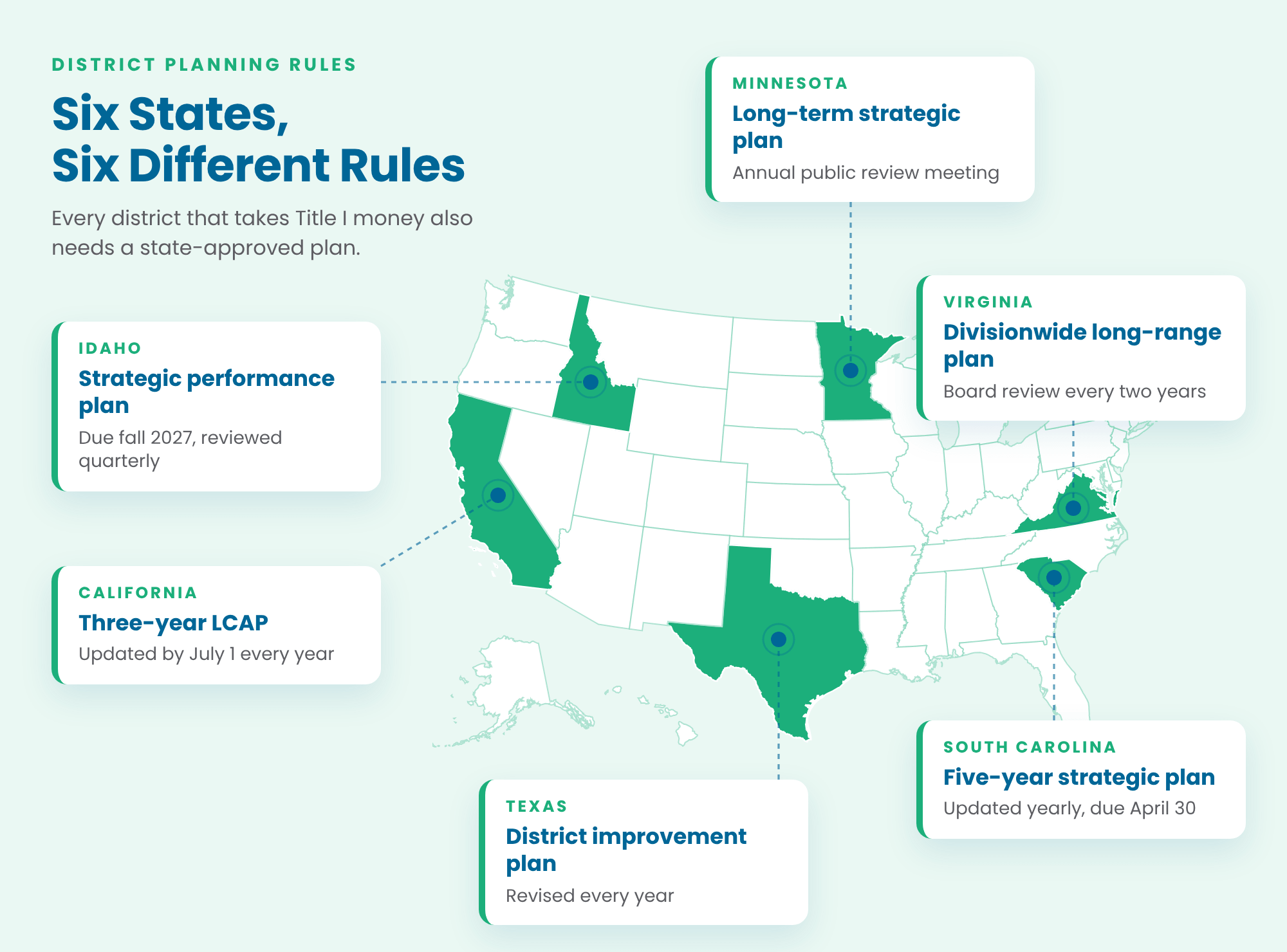
States go further, and they don’t agree on what to call the plan or how often to redo it. Six examples show the range:
- South Carolina: Districts keep a five-year strategic plan with annual updates, due April 30 each year. State rules call for measurable five-year goals with annual interim targets.
- Texas: The superintendent and a district-level committee develop, evaluate, and revise a district improvement plan every year, naming the staff responsible for each strategy and timelines for checking on it. Boards also adopt early literacy and math plans with five years of annual goals and review them at a public meeting each year.
- California: Every district adopts a Local Control and Accountability Plan that covers three years and is updated by July 1 each year, organized around eight state priorities.
- Virginia: School boards adopt a divisionwide long-range plan, review it every two years, hold at least one public hearing before adopting it or any revisions, and report progress to the public by November 1 of each odd-numbered year.
- Minnesota: Under the World’s Best Workforce law, boards adopt a comprehensive, long-term strategic plan at a public meeting, then hold an annual public meeting to review goals and results.
- Idaho: A 2026 law replaced continuous improvement plans with strategic performance plans that cover at least 4 years and are updated every year. The first are due October 1, 2027, and boards must review progress on at least two key areas each quarter at a public meeting.
Why Idaho’s Law Matters for Every Board
Idaho’s law is worth reading even if you work somewhere else, because it puts into statute something most required plans leave out: the board looks at progress more than once a year, and it does so in public.
If your state isn’t listed, start with your state education agency’s school improvement or accountability office. Confirm what the plan is called, how often it’s due, and who approves it. In any case, treat the required plan as the floor for your school district strategic plan.
What Boards Should Track in 2026–27
Required plans are built to be submitted. They cover every program and change once a year. A board, however, governs month to month. Instead, it needs fewer measures, checked more often, with a name next to each one. That gap is a big part of why education plans stall: unclear ownership, weak alignment, poor communication, and slow adoption.
For this school year, these are the measures we’d put in front of trustees:
Student Measures
- Early reading and math: Third-grade results are the measure most boards already care about, and Texas requires campus-level goals for them. State test scores arrive once a year, so pair them with a screener or interim assessment given in fall, winter, and spring. That’s the version a board can act on before June.
- Chronic absenteeism: Nationally, 22.6% of students were chronically absent in 2024–25, down from 23.5% the year before and still well above 15.4% in 2019, according to an American Enterprise Institute analysis reported by K-12 Dive. However, progress has slowed. Also, attendance data comes in weekly, which makes it the earliest warning a board gets.
- Graduation and college and career readiness: Graduation rates move slowly and arrive late, so track what predicts them, such as ninth graders earning credits on time, course failures, and enrollment in advanced or career courses.
Operating Measures
- Enrollment against the budget: Public school enrollment fell 3% from fall 2019 to fall 2024, and federal projections expect a 6% decline from fall 2022 to fall 2031, according to Bellwether. Most states fund districts per student, so enrollment losses usually mean less state money. A priority with no budget line is usually the first one cut.
- Whether the strategies are actually happening: For each initiative in the plan, the board should see an owner, the date of the last update, and the next milestone. Texas already requires district plans to name responsible staff and timelines. Even so, most boards can’t see that information without asking for it.
If a measure can’t change a decision this year, leave it in the required plan and out of the board packet.
How to Connect the District Strategic Plan to Classroom Work
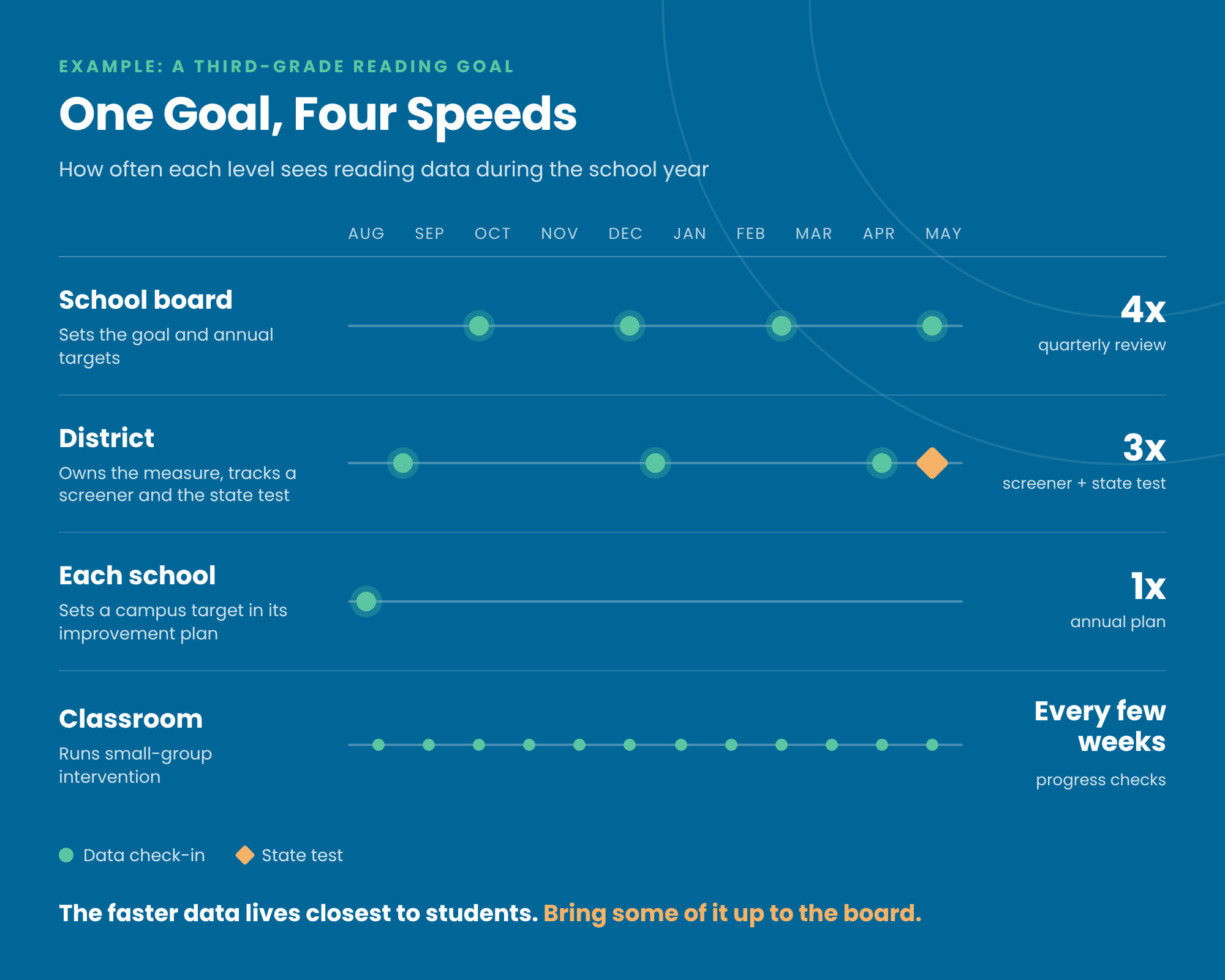
Take one goal and follow it down. Say the board adopts a goal to raise third-grade reading proficiency over three years, with measurable annual targets.
- The board sets the goal and the annual targets, and decides what it will review each quarter.
- The district picks the measures, for example the state reading test once a year and a reading screener three times a year. One named leader, often the chief academic officer, owns the goal.
- Each elementary school sets its own target in its school improvement plan and chooses strategies, like daily small-group intervention for students below benchmark.
- Teachers and grade-level teams run the intervention, check progress every few weeks, and regroup students as they improve.
Where a School District Strategic Plan Breaks Down
The chain tends to break in the same two places. First, school improvement plans get written in a different template than the district plan, so nobody can roll them up. Second, updates travel by email to one person compiling status by hand, so the board sees a snapshot that’s already out of date.
A few habits keep the chain intact:
- Use the same goal and measure names in the district plan and every school plan, so school results roll up without a translation step.
- Give every measure one owner by name, with a backup. Departments don’t send updates. People do.
- Request updates from owners on a set schedule, inside the system where the plan lives, instead of chasing them over email.
- Set the board’s calendar in advance: attendance monthly, screener results after each testing window, the budget tie-out before adoption, and a full plan review once a year. That turns the plan into a review process that runs all year.
What It Looks Like in Practice
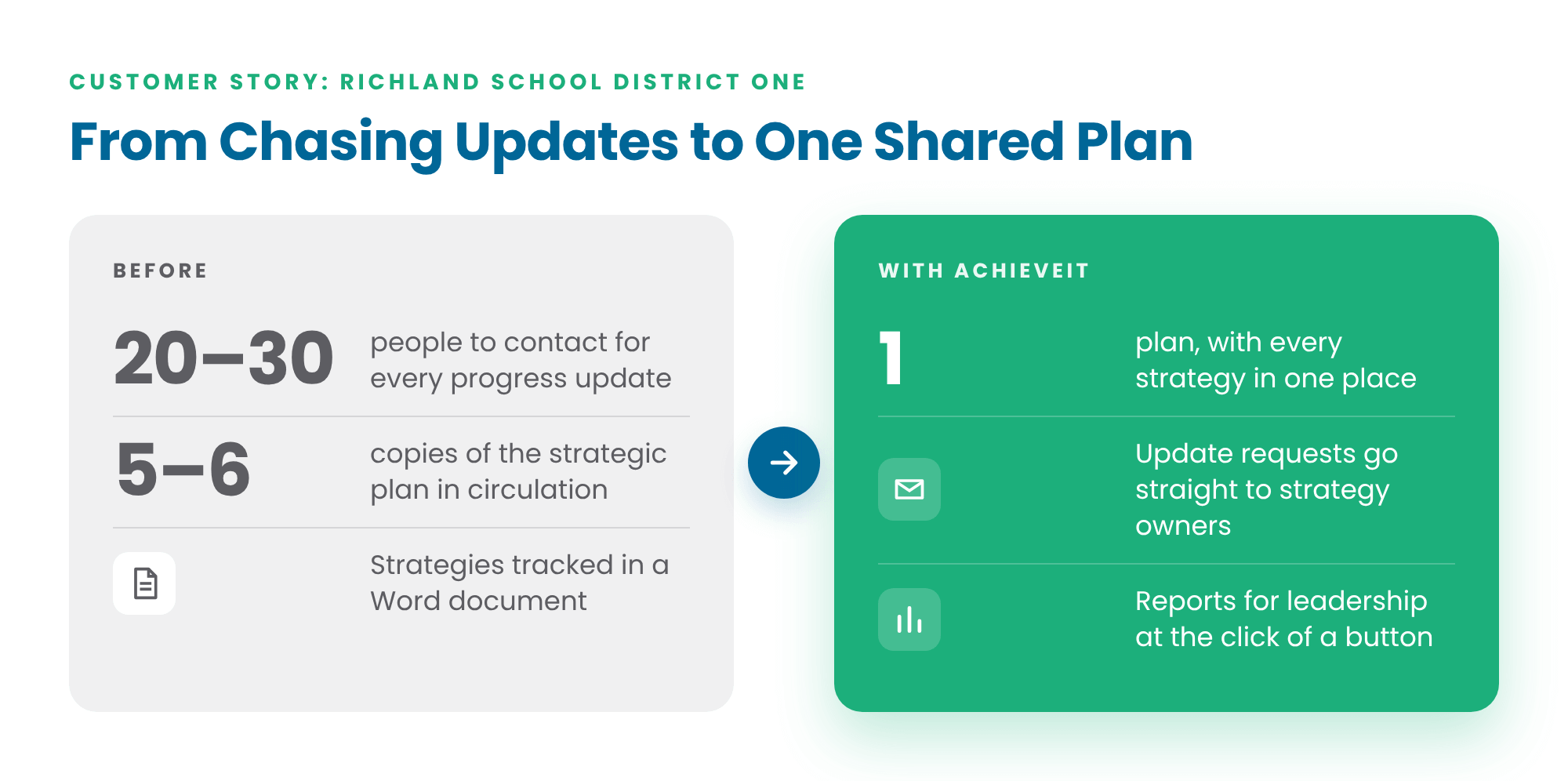
Richland School District One in Columbia, South Carolina, serves about 24,000 students across 52 schools and special centers. South Carolina requires districts to keep a five-year strategic plan with annual updates, so the plan existed. Keeping track of it was the hard part.
Richland One tracked its strategies in a Word document. When leadership asked how the plan was progressing, which could happen at any moment, staff reached out to 20 to 30 people, compiled what came back, and reformatted it into something leaders could use. There were 5 or 6 copies of the strategic plan in circulation, and the updates on progress didn’t always agree.
With the plan in AchieveIt, the information sits in one place. The team requests updates directly from the owners of each strategy, and a report for leadership takes a click. Seeing progress laid out also helped the team move from a long, cumbersome plan to a cleaner, more actionable one. As a result, less time goes into collecting updates and building reports, and more goes into the work that benefits students.
“After implementing AchieveIt, we were able to see how aligned things became.”
Dr. Jennifer Coleman, Executive Director of Accountability, Assessment, Research and Evaluation, Richland School District One
Frequently Asked Questions
There’s no federal requirement for a document called a strategic plan. Districts that receive Title I funds must keep a state-approved plan on file, and most states require a district plan of their own, such as South Carolina’s five-year strategic plan, Texas’s annual district improvement plan, or California’s LCAP. Your state education agency can confirm the exact requirement.
Not always. An improvement plan usually responds to state accountability results and is revised every year. A strategic plan sets longer-term direction, often over 3 to 5 years, with community input. Many districts keep both. The work is making sure they share the same goals and measures.
State rules for the full plan range from every year to every two years. We recommend a quarterly look at a short list of measures, which is what Idaho now requires, plus a full review once a year.
Keep Your School District’s Strategic Plan Moving with AchieveIt
If a trustee asked tomorrow how third-grade reading is trending at each elementary school, how long would it take your team to answer?
AchieveIt gives school districts one place for the strategic plan, school improvement plans, and the measures the board reviews. Owners get update requests on schedule, and board reports come from the same current data. See how it works for K-12 school districts, or take the 3-minute product tour.