

Every organization faces the same fundamental challenge of turning strategy into measurable results. Companies may invest in strategy development, but execution often falls short of expectations. This can lead to stalled initiatives, blurred priorities and projects that underdeliver.
Justifying a strategy software budget can be tricky because the benefits of these solutions are spread across teams and realized over extended periods. Without visibility into their impact, decision-makers may see them as optional overhead.
Learn the importance of calculating the return on investment (ROI) of strategy software and the framework for gaining leader buy-in to budget for strategy execution platforms.
In This Article
- Why Calculating ROI for Strategy Software Matters
- Understanding the Core Value Pillars of Strategy Software
- The Step-by-Step Framework for Calculating Strategy Execution Software ROI
- Intangible Benefits That Strengthen Your Case
- How Our Software Delivers Tangible ROI
Why Calculating ROI for Strategy Software Matters
Finance committees and executive teams prioritize investments that increase revenue or lower risk. Calculating ROI turns intangible improvements into auditable metrics that stakeholders can understand and trust. A business case that links software features to outcomes can expedite approvals and align expectations across the organization.
Areas where strategy software provides value include:
- Coordination and administrative overhead: Teams spend significant time compiling status updates, reconciling plans and chasing owners. Software that automates these tasks frees hours for execution and analysis, which reduces labor costs.
- Misalignment and duplicated effort: Without a single source of truth, groups can work at cross-purposes. Alignment tools reduce rework and free resources for initiatives that deliver value.
- Delayed decisions and time to impact: Poor visibility slows leadership decisions. Data-driven decision-making shortens the lag between approval and realized benefits.
- Risk of stalled or abandoned initiatives: Projects that lose momentum consume sunk costs and forgo potential revenue or margin improvements. Reducing stalled initiatives increases portfolio yield.
- Reporting and compliance costs: Producing accurate reports for boards, investors or regulators often requires repeated manual effort. Automation cuts recurring costs and reduces the risk of errors.
Understanding the Core Value Pillars of Strategy Software
To build a credible strategy execution software ROI model, it’s essential to understand what drives measurable value. Every organization’s context differs, but effective strategy execution systems offer benefits across five pillars.
Improved Strategic Alignment and Focus
Alignment ensures every department and team action supports organizational priorities. A well-oiled connection reduces fragmentation and scattered resources.
The benefits of alignment include:
- Resource optimization: Early identification of redundant or misaligned projects allows teams to direct budgets and staff hours toward higher-value initiatives.
- Execution efficiency: Teams that work in alignment experience fewer interruptions and less rework, reducing time lost to conflicting priorities.
- Higher goal attainment: Organizations that connect daily operations to strategic objectives may experience higher completion rates for initiatives.
Enhanced Operational Efficiency and Productivity
Every strategic plan generates administrative overhead that affects productivity. Strategy software automates routine reporting, centralizes information and streamlines workflows, so teams spend more time executing plans.
Measurable impacts include:
- Reduced manual reporting hours: Automating status updates and dashboards can save managers a few hours per week. Across a 50-person management layer, even two hours saved weekly equates to roughly 5,000 labor hours annually.
- Faster project delivery: Real-time tracking and clarified dependencies reduce avoidable delays, and cycle times may drop after implementing structured execution tools.
- Lower administrative overhead: Fewer ad hoc meetings and duplicated communications reduce friction and free time for higher-value work.
Greater Accountability and Performance Management
Accountability ensures that strategic promises turn into tangible results. In traditional reporting structures, accountability may decrease as information is passed through multiple departments. By the time leadership reviews progress, it can be too late to intervene. Strategy software embeds accountability through clear ownership and transparent performance indicators. Benefits include:
- Improved completion rates: Visible ownership and milestones can improve project delivery at an organization’s desired rate.
- Reduced initiative abandonment: Real-time monitoring enables early course corrections, preventing projects from impacting costs.
- Enhanced performance culture: Transparent tracking encourages peer accountability and fosters coaching based on data.
Accelerated Strategic Agility and Responsiveness
Markets move faster than annual planning cycles, so possessing the capability to adjust resources or execute quickly can give organizations a competitive edge. Strategy software supports agility by providing dynamic planning capabilities and live performance data. Quantifiable advantages include:
- Reduced lag between insight and action: Dashboards allow leadership to pivot as quickly as required.
- Minimized opportunity cost: Early detection of underperforming initiatives enables redeployment of funds and resources to other projects.
- Improved resilience: Agile organizations navigate market disruptions or regulatory shifts with less downtime and fewer losses.
Superior Data-Driven Insights and Decision-Making
Decision-making can impact the success of strategy formulation and execution. Strategic planning software provides ROI by integrating information to create a single view across departments and key performance indicators (KPIs). The tangible impacts include:
- Reduced decision latency: Leaders spend less time collecting and validating information.
- Higher decision accuracy: Decisions based on contextual data reduce the risk of misinformed actions that could waste resources.
- Enhanced forecasting precision: Aligning historical and current data improves budgeting accuracy and capital planning.
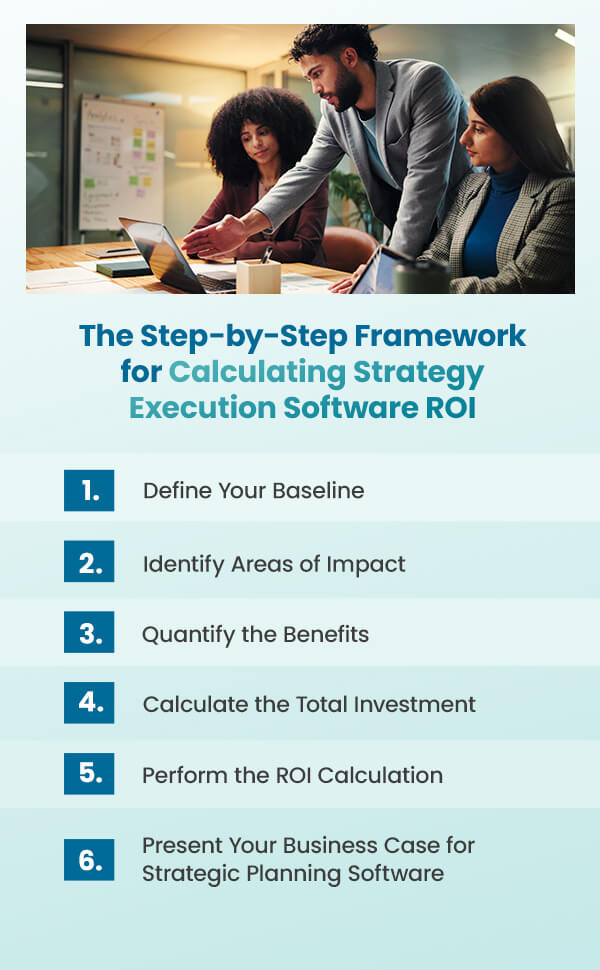
The Step-by-Step Framework for Calculating Strategy Execution Software ROI
Once the value pillars of the strategy software are clear, the next step is to turn them into a quantifiable financial model. This framework provides a structured approach that allows teams to implement a strategy software cost-benefit analysis that links operational improvements to impact.
1. Define Your Baseline
Before measuring potential improvements, establish the current state of operations to base your calculations on the reality of your organization. Aspects include:
- Current project completion rates: Track how many initiatives meet their original objectives on time and within budget to understand existing execution effectiveness.
- Time spent on administrative coordination: Aggregate the hours teams spend on manual reporting, follow-ups and data consolidation to quantify the effort that your organization can direct toward other activities.
- Resource allocation inefficiencies: Identify where duplicated efforts or stalled initiatives consume budget or staff hours.
- Decision cycle lengths: Measure the time from proposal to action on strategic initiatives to highlight delays the software could reduce.
2. Identify Areas of Impact
Next, specify where the software will generate value. Align these areas with the pillars of strategy software:
- Time savings: Automating reporting and progress tracking reduces administrative burdens, allowing team members to focus on execution and analysis.
- Revenue impact: Faster execution of high-priority initiatives accelerates market capture or sales growth, affecting the organization’s top-line results.
- Cost reduction: Reducing duplicated efforts and misaligned projects releases budget and resources that can be reallocated to other initiatives.
- Risk mitigation: Improved visibility enables teams to identify stalled or underperforming projects earlier, thereby reducing the likelihood of incurring sunk costs.
- Productivity gains: Streamlined workflows and centralized objectives enable teams to complete more work in less time, enhancing organizational output.
3. Quantify the Benefits
Always base calculations on organizational figures to ensure a realistic and defensible analysis. Below are examples of aspects for quantifying strategy software value:
- Efficiency: If managers save three hours per week through automated reporting, multiply that figure by their hourly cost and total headcount to quantify direct labor savings.
- Alignment: When teams reduce or consolidate redundant projects, the recovered budget represents real financial value that increases strategic yield.
- Risk mitigation: If early intervention prevents a stalled project that would have cost $50,000, that avoided expense strengthens the ROI case.
4. Calculate the Total Investment
To ensure credibility, the ROI equation must include the full cost of implementation and operation:
- Software subscription: Include annual or multiyear licensing costs as part of the total.
- Implementation fees: Account for onboarding, configuration and consulting for organizational workflows.
- Internal staff time: Include the hours invested by internal teams during deployment and integration.
- Ongoing support and maintenance: Consider vendor support, IT management and periodic upgrades in your total cost calculation.
- Training: Account for initial and ongoing user training to secure adoption and maintain proficiency.
5. Perform the ROI Calculation
With all benefits and investments defined, apply the following formula for financial justification for strategic planning: ROI (%) = (Total Monetary Benefits – Total Investment) / Total Investment x 100%.
Here’s an example to use:
- Total benefits: $250,000
- Total investment: $100,000
- ROI: (250,000 – 100,000)/100,000 x 100 = 150%
A 150% return indicates that for every dollar invested, the organization earns back $1.50 in measurable value.
6. Present Your Business Case for Strategic Planning Software
To gain executive buy-in, present your ROI of strategy software findings in a clear and structured format. Include the following:
- Summary of baseline challenges: Frame the operational inefficiencies or misalignments the investment seeks to resolve.
- Projected benefits: Quantify the expected gains and show the data behind the calculations.
- Investment breakdown: Provide transparency in costs to establish trust and confidence.
- ROI and payback period: Clearly define the return percentage and recovery timeline to set expectations.
- Intangible benefits: Describe strategic and cultural improvements that extend beyond immediate financial returns.
Intangible Benefits That Strengthen Your Case
Financial returns are vital to securing investment, but strategy software delivers value that extends beyond the balance sheet. Explore the top benefits that demonstrate the value of strategy software below.

Improved Organizational Culture
A strategy platform creates an environment for transparency and accountability. Teams no longer operate in silos or chase competing priorities because the system enforces clarity by linking initiatives to an overarching goal. This structure fosters a proactive culture. When strategic progress is visible and measurable, it builds collective trust and normalizes disciplined execution across departments.
Enhanced Employee Engagement and Morale
When employees clearly see how their work contributes to advancing organizational strategy, engagement may improve. Individuals understand their contribution to larger outcomes and can track their progress. This connection between effort and impact creates intrinsic motivation, helping sustain performance.
Strategy platforms also reduce frustration by minimizing redundant work and reducing last-minute reporting confusion.
Better Competitive Positioning and Market Reputation
Organizations that execute strategy with precision can outperform those that rely on fragmented reporting. Strategy software turns execution discipline into a market advantage by enabling faster adaptation to emerging trends and customer demands. When external stakeholders observe that objectives are met predictably and progress is transparent, it enhances the organization’s credibility.
Increased Stakeholder Confidence
Stakeholders depend on visibility to make informed decisions. When performance KPIs and risks are centrally tracked, confidence in the leadership team increases. This transparency enhances governance and streamlines decision-making processes related to funding and approvals. Stakeholders become more comfortable authorizing initiatives because they trust that teams will monitor performance and address issues early.
Improved Organizational Learning and Institutional Knowledge Capture
A strategy platform allows each project and outcome to form part of a searchable record that informs future planning. Organizations can refine processes by retaining data on performance patterns and execution barriers. These cumulative insights strengthen planning accuracy and enhance the organization’s long-term adaptability.
How Our Software Delivers Tangible ROI
AchieveIt supports strategic planning software ROI by transforming reporting into a measurable performance metric. Each capability can help reduce waste and strengthen decision-making:
- Real-time dashboards: With real-time dashboards, you have a clear view of your goals, milestones and progress. Live data updates ensure that every decision is based on accurate information. You can see where momentum is building, identify potential bottlenecks and guide resources where they’ll have the most impact.
- Automated reporting and alerts: AchieveIt’s automated reporting and alert system keeps you informed and agile. Reports are generated and shared automatically, while real-time alerts highlight emerging risks or off-track items. You and your teams spend less time gathering data and more time acting on it.
- Advanced reporting and analytics: AchieveIt’s advanced analytics unify your strategic, operational, and departmental plans into a single actionable view. You can track KPIs, drill into performance data and translate insights into targeted actions. These insights empower you to capitalize on what’s working and fine-tune strategies.
- Multi-plan integration: With AchieveIt, every plan and initiative connects seamlessly. This unified structure gives leaders a complete view of progress and interdependencies, helping teams coordinate priorities and share resources efficiently. When all plans work together, you eliminate duplication, strengthen collaboration and maximize the return of every investment.
- Goal tracking and data visualization: AchieveIt’s goal tracking turns complex data into clear insights. Whether you’re viewing progress on a chart or monitoring trends, you can identify where performance is strong and areas that require focus next.

Empower Your Strategic Future With AchieveIt
AchieveIt’s software provides a strategic execution system that helps you plan smarter, align and deliver measurable outcomes across your organization. Our team works with you to streamline planning and strengthen accountability. You gain clear visibility on where to deploy resources for a more agile organization that adapts and delivers results.
AchieveIt combines advanced software with a dedicated partnership. From onboarding and training to strategic consulting, our experts work with you to refine plans, enhance reporting cadence and build lasting execution capability.
Request a demo today or take a self-guided product tour to see firsthand what it’s like to execute your plans inside AchieveIt.