

Special district planning isn’t broken, but the way most districts try to execute their plans often is. Unlike general-purpose municipalities that juggle dozens of services, special districts focus on a limited number of critical functions — delivering clean water, managing stormwater, maintaining transit systems or keeping the lights on. That narrow focus demands a different approach to strategy.
Most special districts borrow planning frameworks designed for cities and counties. These frameworks look comprehensive on paper, but rarely account for the realities that special districts face daily. The result? Strategic plans sit in binders while the real work happens in disconnected spreadsheets, siloed departments and endless email chains.
The gap between planning and execution isn’t a failure of strategy. It’s a failure of follow-through — the systems and processes that translate plans into accountable, visible action.
In This Article
- Why Do Special Districts Need Tailored Planning?
- Understanding the Unique Challenges of Special District Strategy
- Key Elements of Effective Strategic Planning for Special Districts
- Special District Governance Best Practices for Developing and Implementing Strategic Plans
- The Core Principles That Work for Special Districts
- Putting Your Adaptive Plan Into Action
- Building Sustainable, Accountable Special Districts
Why Do Special Districts Need Tailored Planning?
Most strategic planning frameworks assume the complexity of general-purpose local governments serving diverse constituencies with competing priorities. But special district management faces a different challenge. Because revenue comes primarily from user rates rather than diverse tax bases, direct accountability between service quality and what ratepayers pay is essential. Planning for these organizations must account for these differences.
Special districts must deliver one service exceptionally well while maintaining financial sustainability over decades of infrastructure life cycles. When districts apply generic planning models, they end up with strategies that sound comprehensive but don’t translate into the technical, financial and operational decisions that actually move the organization forward.
Understanding the Unique Challenges of Special District Strategy
Special districts operate in a fundamentally different environment than other government agencies. Understanding these unique challenges is the first step toward strategic planning that actually works.
- Governance complexity: Special districts navigate multiple jurisdictions, work with appointed boards that bring specialized technical knowledge and operate under accountability structures that differ from elected officials. Board members often serve because of their engineering or financial expertise, not political savvy. This creates strategic planning dynamics where technical feasibility must be front and center, not an afterthought.
- Financial constraints: Rate-dependent revenue means every dollar comes directly from the people you serve. There’s limited ability to diversify revenue streams the way cities can. Infrastructure needs often exceed available capital, requiring careful prioritization across decades-long replacement cycles. When regulations change or environmental standards shift, the financial impact lands squarely on ratepayers. Plans must account for what’s technically necessary and what’s financially sustainable.
- Stakeholder dynamics: Your stakeholder base is narrow but sophisticated. Ratepayers understand that service reliability and rate sustainability go hand in hand. Large industrial or agricultural users often have deep technical knowledge and significant influence. Community expectations center on two non-negotiables — don’t let the system fail and don’t let rates spike unexpectedly. Planning must balance these shared outcomes while maintaining transparency.
- Siloed decision-making: Engineering makes infrastructure decisions. Finance sets rates. Operations manages daily service delivery. When these functions operate independently, the result is local optimization that creates global problems. One utility company we studied discovered that engineering was planning major capital projects without coordinating with finance on rate impacts, creating unexpected increases that blindsided ratepayers.
Consider what happens when rate-setting decisions don’t coordinate with operational staffing plans. Finance implements cost-cutting measures that reduce personnel expenses. Operations then struggles to maintain service levels with fewer technicians. Customer complaints rise, system response times increase, and the board demands explanations. No single department failed. The problem was the absence of integrated strategic execution.

The solution starts with better planning practices that build coordination and accountability into your approach from the beginning.
Key Elements of Effective Strategic Planning for Special Districts
Effective planning for special districts requires specific elements that translate high-level direction into operational reality. These components form the foundation of any plan that moves beyond the binder:
- Vision and mission: Your vision defines the future state you’re creating, while your mission explains why you exist. For special districts, this clarity matters more than it does for multi-service agencies. When your district’s entire purpose is to deliver reliable water systems, that mission should cascade through every strategic decision. A clear vision gives your technical staff, board and community a shared definition of success.
- Goals and measurable objectives: Aspirational goals sound impressive, but don’t drive execution. “Improve system reliability” is aspirational. “Reduce unplanned service interruptions by 15% within 18 months by implementing predictive maintenance protocols” is actionable. Special districts need objectives with specific metrics, defined timelines and clear ownership. Without measurement, you’re managing by anecdote rather than evidence.
- Stakeholder engagement: Your board brings technical expertise and governance oversight. Your staff executes the work. Ratepayers fund operations and expect accountability. The broader community depends on reliable service. Early engagement with all these groups builds support and surfaces technical constraints, financial realities and operational challenges before they become expensive surprises. When defining your vision, stakeholder input ensures strategies are grounded in reality, not wishful thinking.
- Budgeting and financial planning: Strategy and budget must be the same conversation, not sequential activities. When key objectives are set independently from financial planning, you end up with unfunded mandates. Infrastructure replacement strategies need rate models that show multiyear financial impacts. Capital improvement plans require debt service projections. Separating strategy from budget guarantees execution failure.
- Accountability and clear ownership: Every strategic initiative needs an owner responsible for delivery and a mechanism to track progress. Vague ownership, like “the engineering department will handle this,” invites diffusion of responsibility. Specific ownership, like “Director of Engineering Jane Smith will reduce main breaks by 20% by December 2026,” creates accountability. Without clear ownership and measurement, plans become suggestions rather than commitments.
Special District Governance Best Practices for Developing and Implementing Strategic Plans
Creating a strategic plan is one thing. Executing it is another. These seven practices separate districts that achieve their strategies from those that watch plans collect dust.
- Start with an honest assessment of current performance: Before planning where you’re going, understand where you actually are. Not where you think you are or wish you were, but what the data shows about system performance, financial health, operational capacity and stakeholder satisfaction. This baseline becomes the foundation for setting realistic goals and measuring progress.
- Engage stakeholders comprehensively: Your board needs to understand trade-offs and make informed governance decisions, while staff must see how their daily work connects to organizational goals. Beyond internal alignment, ratepayers and community members deserve transparency about service levels and rate implications. Securing executive buy-in from leadership stakeholders is the difference between a plan that guides decisions and one that sits on a shelf.
- Define strategy clearly with explicit trade-offs: Resources are finite. Accelerating infrastructure replacement, holding rates flat, expanding service territory and increasing system redundancy simultaneously isn’t possible. Real strategy means choosing what matters most and acknowledging what you won’t prioritize. Leading from the center means orchestrating these trade-offs across departments so everyone moves in the same direction.
- Translate strategy into budgets and operational plans: Key objectives must appear in your annual budget as funded line items, with capital improvement plans referencing the specific goals they support. At the operational level, plans need to show how daily activities advance broader aims. This translation makes strategy tangible and actionable rather than aspirational.
- Create transparency and accountability mechanisms that make progress visible: Regular reporting to the board and community demonstrates stewardship, while internal dashboards help staff see how their work contributes to larger goals. Clear metrics prevent “strategic drift” where urgent daily demands slowly pull the organization away from stated priorities. Strategic planning alignment frameworks from organizations, like the federal government, show how integrating accountability mechanisms drives consistent execution.
- Enable iterative adjustment based on changing conditions: Long infrastructure life cycles require long-term planning, but annual rigidity guarantees failure. Regulatory changes, unexpected infrastructure failures, economic shifts and technology advances will disrupt even the best plans. Build in quarterly or semiannual review cycles that allow course corrections without abandoning strategic direction.
- Communicate relentlessly about strategy, progress, challenges and changes: Keeping staff aligned requires consistent internal communication, while board updates maintain governance engagement. Building trust with ratepayers demands community transparency. Communication is the mechanism that keeps strategic execution visible and relevant across the organization.
The Core Principles That Work for Special Districts
Beyond best practices, three core principles distinguish effective special district strategy from generic government planning frameworks that miss the mark.
You must ground strategy in technical reality. Unlike general government planning, where political priorities can override technical constraints, special districts lack the luxury of ignoring engineering requirements or operational necessities. Deferring critical infrastructure replacement beyond safe operational limits isn’t a viable strategic choice. Your planning must start with what the systems, regulations and technical standards actually require, then build financial and operational strategies around those realities.
Rate revenue requires explicit accountability to ratepayers. Every strategic investment ultimately appears in rates. This creates a different stakeholder dynamic than tax-funded agencies experience. Plans must make the connection between service improvements and rate impacts transparent and understandable. A utility company we worked with transformed its strategic communication by showing ratepayers exactly how capital investments protected long-term rate stability, building support for necessary projects.
A long-term infrastructure mindset distinguishes special districts from other government entities. Managing assets with 50-year life cycles means planning operates on different timescales than agencies focused on annual program delivery. This requires frameworks that track multi-decade capital cycles, forecast long-term financial sustainability and maintain institutional knowledge across staff turnover. Short-term thinking in special districts creates expensive long-term consequences.
Putting Your Adaptive Plan Into Action
You now have a framework for developing strategic plans tailored to special districts — clear elements, proven practices, and core principles that address your unique challenges. These practices work, and districts implementing them see better alignment, clearer accountability and measurable progress toward their goals.
The challenge many districts face isn’t knowing what good planning looks like. It’s operationalizing these practices across the organization. When plans live in Word documents, budgets exist in Excel spreadsheets, project tracking happens in separate systems, and operational performance gets reported through different tools, maintaining the coordination and visibility these practices require becomes a manual, time-intensive process.
Department heads maintain their own status reports. The general manager spends hours before each board meeting consolidating updates from across the organization. When the board asks how a specific strategic initiative connects to budget performance or operational outcomes, answering that question requires digging through multiple disconnected sources. This fragmentation creates friction, making even well-designed plans harder to execute consistently.

The districts that excel at strategic execution invest in integrated systems that reduce this friction. Instead of managing strategy through disconnected tools and manual processes, they use platforms that bring planning, budgeting, operational tracking and accountability together in one place where everyone works from the same information.
When engineering proposes a capital project, finance can immediately see rate implications. When operations identifies a performance gap, leadership can assess strategic impact. Board questions about progress get answered with real-time data, not last month’s manual update. What utility companies reported after implementing integrated execution systems was telling — not fundamentally different strategies, but a dramatically better ability to execute the strategies they already had.
Five capabilities define these integrated systems:
- Planning that connects strategy across all departments
- Transparent accountability so everyone knows who owns what and how it’s progressing
- Rapid adjustment mechanisms that enable course corrections based on changing conditions
- Clear reporting that demonstrates value to ratepayers
- Strategic alignment that ensures daily decisions support long-term priorities
Whether you implement these practices through disciplined manual processes or accelerate them with integrated systems, the framework remains the same. The difference is the speed and consistency with which you can execute.
Building Sustainable, Accountable Special Districts
The combination of technical complexity, rate-based accountability, governance structure and long infrastructure life cycles creates unique execution challenges for special districts. Generic planning frameworks weren’t designed to address these realities.
The framework you’ve gained through this article gives you the specific elements you need to include in your plan, proven practices for implementation and core principles that ensure your approach fits special district realities. You can start applying these immediately, whether you’re developing a new strategic plan or improving how you execute your current one.
Excellent execution requires visibility into how every part of the organization connects to overarching goals. Ensure alignment between plans and budget realities, and deploy real-time tracking that shows progress and problems before they become crises. Implement rapid adaptation mechanisms when conditions change, and maintain transparent accountability to boards and ratepayers about what you’re accomplishing with their resources.
The districts that consistently turn plans into results have built these capabilities into their approach. Some do it through rigorous manual processes and disciplined coordination. Others accelerate the process through integrated systems that reduce friction and increase visibility. The path you choose depends on your organization’s current capacity and resources.
The question isn’t whether your district can build an effective strategic plan. You now have the framework to do exactly that. The question is how quickly you want to move from planning to results.
Ready to Accelerate Your Strategy Execution?
You’ve done the hard work of understanding what effective strategic planning looks like for special districts. You have the framework. The practices are clear. Now comes the execution.
If you’re ready to operationalize these practices without the manual coordination burden that slows many districts down, AchieveIt can help. Our platform helps special districts connect, manage, and execute key plans and initiatives through a single, integrated system. Assign clear ownership, track progress in real time and demonstrate accountability to ratepayers and boards.
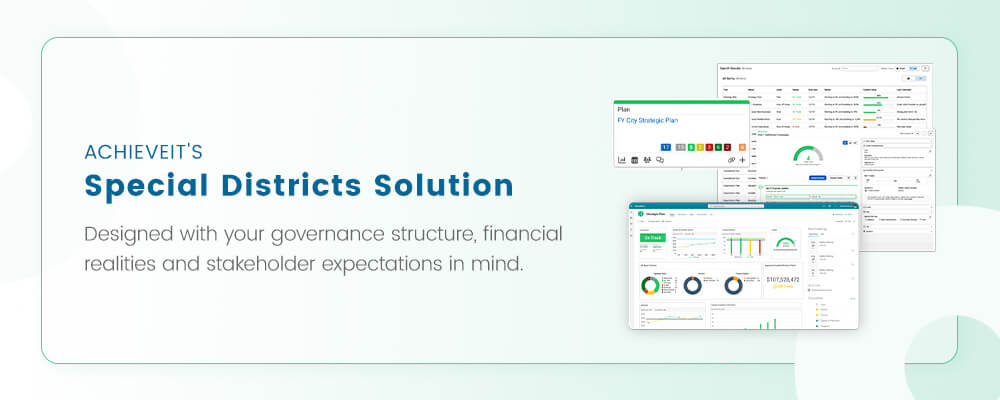
AchieveIt’s Special Districts solution was designed with your governance structure, financial realities and stakeholder expectations in mind. Request a demo to see how special districts use AchieveIt to move from planning to doing, or explore how utility companies transformed their strategic execution with integrated execution systems.