

Though many organizations invest significant time developing strategic plans, execution often stalls. Studies from strategy and management researchers show that nearly 70% of strategies fail to achieve their intended results. Leaders set priorities, map initiatives and outline milestones, but monitoring progress becomes challenging once the plan leaves the boardroom. The organization moves slowly, despite teams that diligently complete assignments on time. This disconnect is typical in environments built on busywork like spreadsheets and email requests.
The root issue is simple — many teams rely on systems that only track activity. Tools that only focus on assignments or project updates capture progress at the task level, but they do not clarify whether that work advances the strategy. Even while lower-level employees work through their to-do lists, leaders lack a view of alignment, dependencies and long-term performance.
Modern strategic management software closes this gap by connecting initiatives to enterprise goals and giving leaders the context they need to guide execution. This article explores that crucial distinction. It examines task tracking versus strategic management, explains how advanced software bridges the gap between action and alignment and outlines how organizations can move from task-based execution to integrated, outcome-driven planning.
In This Article
- What’s the Difference Between Task Tracking and Strategic Management?
- Why “Just Tracking Tasks” Leads to Strategic Failure
- Unlocking Strategic Management Through Planning Software
- The ROI of Moving From Task Tracking to Strategic Management
- How to Improve Your Planning Approach
What’s the Difference Between Task Tracking and Strategic Management?
Organizations often treat task tracking and strategic management as interchangeable concepts. Both involve progress updates and milestones, yet their purpose and value differ. Leaders who understand these core differences can allocate their time and resources more effectively.
Task Tracking
Task tracking tools organize operational details. They help teams assign responsibilities, set deadlines and record progress on specific projects. Consider these pros and cons.
- Operational focus: They manage the how of daily work instead of the why behind it.
- Completion-based success: Teams measure their progress by hitting deadlines.
- Isolated visibility: Each department uses different tools, limiting cross-functional insight.
- Static measurement: Dashboards typically show progress, but not whether those tasks contribute meaningfully to organizational goals.
These tools help teams operate efficiently, especially at the project level. However, they rarely offer strategic insights. In this model, success often means hitting deadlines and staying within scope, even if the work doesn’t mesh with broader business goals.
Strategic Management
Where task tracking measures outputs, strategic management evaluates outcomes. Instead of asking, “How much work did you do?” leaders ask, “Did this drive the intended result?” This approach leads to multifaceted advantages.
- Alignment with vision and goals: Every initiative ties to an overarching strategic outcome.
- Resource prioritization: Organizations allocate limited time, budget and personnel based on impact, not urgency.
- Performance measurement: Prioritizing progress toward KPIs and outcomes instead of task completion.
- Cross-functional visibility: Teams view how their work contributes to enterprise-wide goals, breaking down silos.
- Adaptability: Leaders can quickly adjust initiatives in response to new data or market changes.
The challenge is that many teams mistake operational efficiency for strategic momentum. A project may finish on time and under budget, yet still fail to drive value if it didn’t match business objectives. Leaders who lack visibility into outcomes or an apparent link between activity and impact risk investing in busywork instead of results.
Modern strategic planning software bridges this gap by offering tools that link day-to-day execution with high-level strategy. However, it requires a shift in thinking from managing tasks to encouraging progress toward accomplishing shared goals.
Relying solely on task tracking creates risk. Teams may stay active without alignment, priorities can fragment and leadership loses the ability to quantify whether their strategy delivers value. Proper strategic management replaces scattered task updates with coordinated, goal-driven execution.
Why “Just Tracking Tasks” Leads to Strategic Failure
Many organizations rely on activity-based systems because they seem familiar and straightforward. Though they help teams stay organized and maintain momentum, they lack the structure required to execute long-term strategies.
Without a framework that connects daily work to enterprise priorities, teams focus on outputs rather than outcomes. Leaders receive progress updates, yet they cannot see whether these updates reflect meaningful strategic movement. This disconnect limits organizational performance and creates a false sense of progress.
Here are four pitfalls organizations encounter when they concentrate solely on surface-level execution.
1. No Big-Picture Alignment
Siloed teams tend to operate independently, pursuing separate goals instead of moving in sync. Salespeople chase revenue targets, while operations focus on removing bottlenecks. Without a shared strategy, departments head in different directions, creating fragmented progress. The result is an organization where activity is high but impact is inconsistent, leaving growth uneven and opportunities underused.
2. Poor Prioritization
When every assignment appears equally crucial, teams struggle to focus their efforts where they matter most. Critical initiatives that could significantly accelerate an organization’s impact may receive the same level of attention as routine administrative work. Lack of prioritization results in resource dilution and reduces the return on investment.
3. Lack of KPIs and Metrics Tied to Outcomes
Finishing a task doesn’t necessarily mean it was successful. Without defined KPIs, organizations have no way to know if an initiative delivered results. Metrics such as revenue growth, customer satisfaction or cost reduction should guide decision-making — not the number of items on a checklist.
4. Reduced Visibility for Leadership
Executives need a top-down view of performance to guide their decisions. Activity-based systems provide scattered information across departments, making it challenging to identify patterns, risks and dependencies. Leadership teams must piece together updates from multiple spreadsheets or systems, which slows decision-making and increases the likelihood of things falling through the cracks.
Example scenario: Consider a company that launches a marketing automation project. The implementation finishes on schedule and within budget. On paper, it looks successful. Months later, leadership realizes that customer acquisition has barely improved because the project didn’t match the organization’s growth blueprint. Though teams met their operational objectives, their work lacked strategic relevance.
Unlocking Strategic Management Through Planning Software
Focusing solely on task tracking makes an organization look productive without progressing. Transitioning to strategy execution software can close this gap with tools that unify planning and execution. Strategic management software provides that bridge. Rather than managing isolated projects, it enables organizations to integrate every initiative into a single, connected framework, helping leaders understand how each effort contributes to the enterprise’s goals.
Modern strategic planning software consolidates data, automates updates and delivers real-time visibility across departments. It allows executives to spend less time chasing reports and more time analyzing results. By embedding accountability and performance measurement into a single system, it transforms disconnected activities into coordinated strategy execution.
These five capabilities elevate planning software beyond task tracking.
1. Alignment Dashboards
Alignment dashboards offer a centralized view that connects projects, programs and departmental plans to the broader mission and strategic goals. These dashboards help stakeholders see how every initiative contributes to the organization’s direction, fostering transparency and reinforcing alignment across teams.
For example, a health care system managing quality improvement initiatives across multiple hospitals can use alignment dashboards to view each site’s contributions to enterprise-wide patient care goals. Executives can quickly assess whether site-level initiatives support broader health outcomes, and where gaps exist.
2. Outcome Measurement
Outcome measurement features allow organizations to define and monitor KPIs that reflect success. These may include customer retention, revenue growth, policy compliance, service delivery metrics or other relevant results.
Instead of organizing a training session and never following up on it, outcome tracking enables a team to report that the training improved staff productivity by a specific metric directly tied to business impact.
3. Scenario Planning and Forecasting
Scenario planning tools allow organizations to test different options before committing resources. Leaders can examine trade-offs, evaluate risk, forecast outcomes and anticipate resource constraints. This capability enables teams to adapt to uncertainty by using data instead of relying on guesswork. It also allows leadership to select the most strategic path forward, improving resilience and agility.
4. Resource Allocation Tools
By linking financial and human resources directly to strategic objectives, planning software helps leaders allocate capital, time and talent to initiatives that drive the highest return. This approach maximizes organizational efficiency and prevents teams from overspending on low-impact efforts.
5. Accountability Structures
Accountability structures assign ownership to initiatives tied to strategic goals. Instead of tracking who completes tasks, leaders focus on who is responsible for the outcomes. Accountability clarifies responsibilities and supports a culture of performance. Clarity is especially powerful in large organizations where multiple teams contribute to a single result. Without structured accountability, delays and ambiguity will easily derail execution.
The ROI of Moving From Task Tracking to Strategic Management
Organizations that evolve beyond simple task tracking gain operational efficiency and unlock measurable value. Strategic management platforms deliver financial and cultural returns through planning software ROI.
Tangible Benefits
The most immediate benefits of modern planning platforms are operational.
- Improved efficiency: Automating updates and consolidating plans eliminates time-consuming manual reporting and rework. Teams no longer spend hours gathering data or attending redundant status meetings. Instead, updates flow directly into real-time dashboards that reflect accurate progress and performance.
- Reduced duplication: When every initiative connects to shared goals, organizations can redirect more resources toward higher-value endeavors, thereby maximizing human and financial capital.
- Better prioritization: A strategic framework allows leaders to rank initiatives based on impact instead of urgency. Projects that drive measurable results rise to the top, minimizing low-value work. This disciplined prioritization improves return on effort and strengthens decision quality.
Intangible Benefits
While subtle gains are harder to quantify, they often lead to lasting cultural change.
- Stronger accountability: With clearly identified initiative owners and visible progress, every team member feels empowered to take ownership.
- Greater engagement: Employee engagement rises when teams understand the strategic importance of their efforts. Seeing how their contributions influence organizational success increases motivation, collaboration and retention — especially when leaders deliberately recognize results.
- Clarity of purpose: Real-time dashboards and alignment frameworks eliminate guesswork, pointing everyone toward the same target.
These intangible benefits often compound the financial gains by improving agility and long-term sustainability.
Calculating ROI for Planning Software
Organizations can evaluate the return on their strategy execution software through three measurable dimensions.
- Time savings: Calculate hours reduced in reporting, data collection, manual tracking and meeting preparation.
- Risk reduction: Quantify the costs avoided by preventing failed or misaligned initiatives. If a single misaligned project costs an average of $50,000 in inefficiencies, it’s easy to see how preventing even one failure delivers immediate value.
- Faster decision-making: Estimate financial impact from acting on insights sooner.
Consider this simple example. A midsized organization previously spent 10 hours per month per department compiling status reports. They reduced that time to two hours by adopting automated dashboards. Multiply the eight-hour savings across 10 departments and 12 months, and the result is 960 labor hours saved annually — equivalent to nearly six months of full-time work.
Similarly, if 15 managers each save two hours per week by automating updates, that equals 30 hours weekly, or roughly 1,440 hours annually. At an average loaded labor cost of $60 per hour, the time savings alone equate to $86,000 per year. Add to that the reduction in failed initiatives — for instance, avoiding two projects worth $200,000 each — and the total annual benefit reaches $486,000. The ROI is substantial and ongoing compared to the cost of a connected planning platform.
How to Improve Your Planning Approach
Moving from task tracking to strategic management is a technological and cultural evolution. The goal is to create an environment where connected systems and engaged teams continuously execute, measure and refine strategy.
Practical Steps for Leaders
Leaders can start with the following steps to shift from task tracking to proper strategic management.
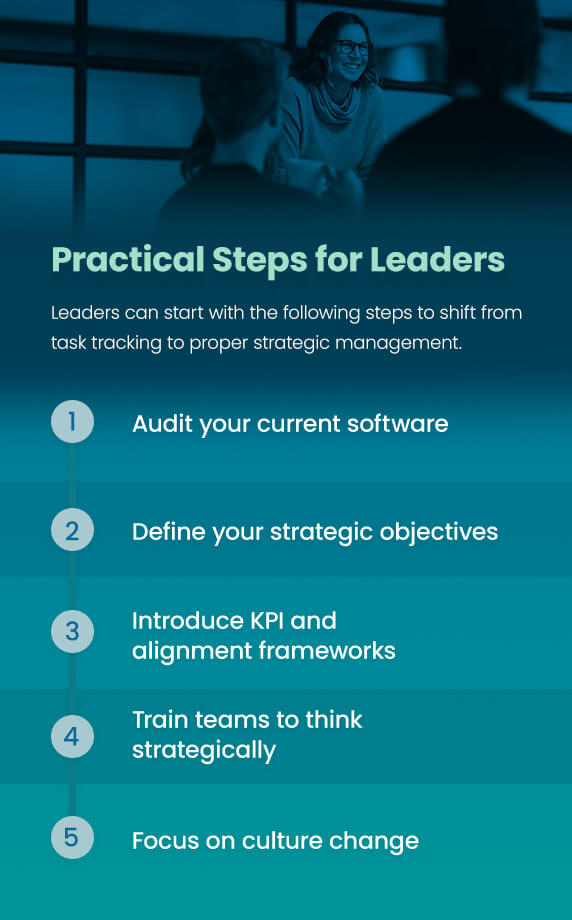
- Audit your current software use: Evaluate whether your existing tools merely track activity or tangibly link projects to strategic outcomes.
- Define your strategic objectives: Clarify what success looks like for your organization. Tools are most effective when built around well-defined goals.
- Introduce KPI and alignment frameworks: Introduce models such as objectives and key results or the balanced scorecard to translate vision into measurable targets that guide every department.
- Train teams to think strategically: Help users understand how their tasks contribute to the big picture. Strategic literacy is as essential as platform fluency.
- Focus on culture change: Emphasize cultural shift as much as technology adoption. Strategic execution relies on shared visibility, firm ownership and consistent communication across departments. Software amplifies these habits, but culture makes them stick.
Beyond Busywork to Real Impact

Many organizations equate busy schedules with meaningful progress. Nonetheless, activity alone does not advance a strategy. Task completion without context creates momentum without direction, leaving leaders unsure whether their work contributes to long-term objectives. When organizations shift to strategic management, they gain a system that connects daily actions to measurable outcomes.
As a leading strategic management software, AchieveIt helps organizations bridge the gap between planning and execution by linking every goal, initiative and update within one unified system.
With AchieveIt, leaders gain real-time visibility into how their strategies are progressing — from enterprise goals down to individual initiatives. The platform automatically collects updates, builds dynamic dashboards and centralizes data so teams can focus on progress. Its alignment dashboards, built-in accountability structures and flexible KPI tracking capabilities make it easy to see how every action contributes to larger objectives. Request a demo or take a self-guided product tour to see what effective strategic execution looks like.