

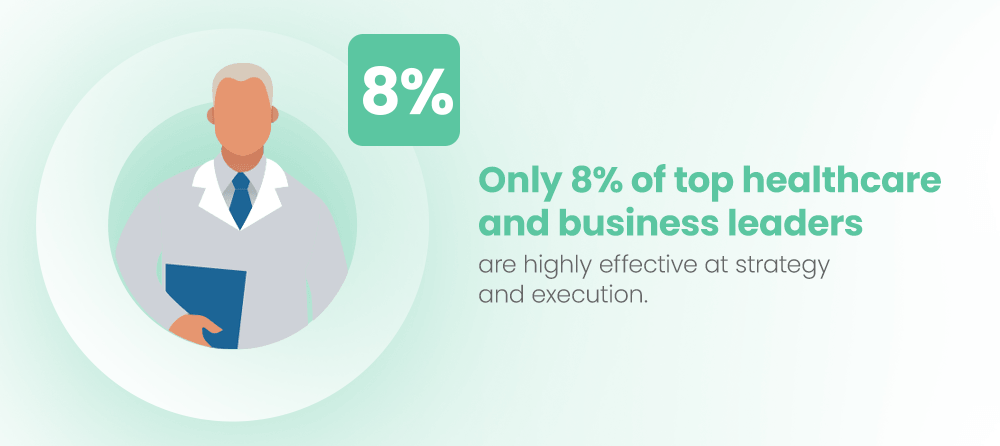
Only 8% of top healthcare and business leaders are highly effective at strategy and execution. The other 92% continually struggle, not because they lack vision, but because their organizations don’t have the infrastructure to bring strategies to fruition.
Too often, well-crafted plans stall the moment they encounter reality. Service lines operate independently, manual reporting drains clinical capacity and no one has a unified view of progress or accountability. Leaders know what needs to happen, but if they can’t see it unfolding in real time, they won’t have a chance to intervene before small gaps turn into systemic failures and their organizations slip back into reactive management.
This guide explains how to reverse that pattern by aligning departments, establishing accountability and breaking down silos.
In This Article
- 5 Common Challenges in Healthcare Strategy Execution
- Proven Methods to Align Departments and Drive Execution
- Overcoming Roadblocks in Healthcare Strategy Implementation
- Driving Sustainable Healthcare Performance Improvement
- Successfully Execute Healthcare Strategies With AchieveIt
5 Common Challenges in Healthcare Strategy Execution
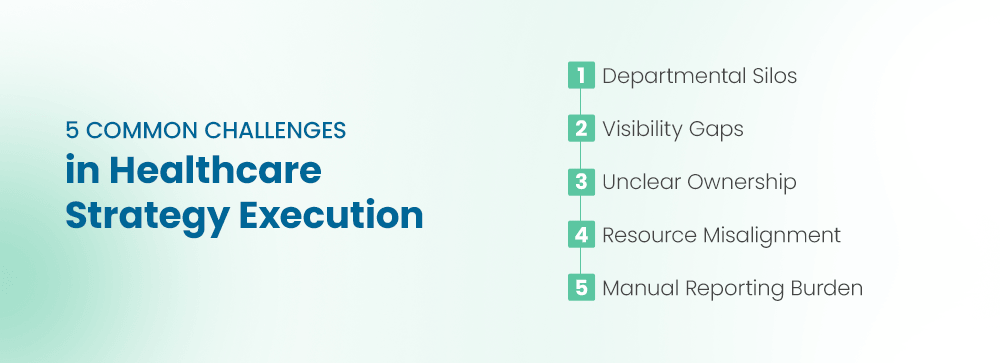
Hospital strategy implementation breaks down in predictable ways. These five challenges compound, obscuring ownership, misusing resources and causing even well-thought-out strategies to fail before reaching the frontline.
1. Departmental Silos
Mistakes quickly compound when clinical, administrative, financial and operational teams pursue separate goals and rarely coordinate to identify duplicated efforts or conflicting priorities.
Patients pay the price when healthcare departments struggle to collaborate, with consequences that extend beyond inefficiency. The Joint Commission discovered that sentinel events rose by 19% and identified teamwork as a root cause. They also found that 88% of those events occurred in hospitals.
2. Visibility Gaps
Leaders who track progress with spreadsheets, email chains and quarterly status meetings are always looking in their rearview mirror. They set direction at the top, but the information loses momentum as it filters through layers of management.
This lag leads to slow decision-making, causing organizations to react to setbacks instead of anticipating them. Executives discover stalled initiatives only when they become crises, while frontline teams can’t see how their daily work connects to broader goals.
3. Unclear Ownership
When departments share responsibility, no single point of contact owns the outcome. An initiative can easily slip through the cracks when everybody assumes someone else will handle it.
This ambiguity is especially dangerous in healthcare. When accountability isn’t explicit, strategic initiatives drift, quality improvement projects stall and performance targets go unmet. As a result, the organization spends resources on plans that never materialize into measurable change.
4. Resource Misalignment
When separate teams complete resource and strategic planning in disjointed cycles, it results in strategy documents and budget decisions that conflict rather than reinforce each other.
For example, a health system may decide to prioritize population health management, but then allocate staff and capital toward short-term operational pressures instead. The strategy says one thing, but the budget does another. As a result, frontline teams must execute contradictory directives with insufficient resources to accomplish either goal effectively.
5. Manual Reporting Burden
Collecting data manually pulls clinical and operational staff away from the work that matters most. A study of Johns Hopkins Hospital tracked the full burden of reporting 162 mandatory quality metrics. The findings illustrate how manual reporting consumes vast resources and pulls staff away from critical patient care and meaningful analysis. The hospital spent:
- $5.04 million in personnel costs plus $602,730 in vendor fees
- 108,478 person-hours per year on quality metric reporting
- 65.5% of all hours on data collection and validation alone, not analysis or action
Proven Methods to Align Departments and Drive Execution
Healthcare alignment strategies must incorporate structural changes that address visibility, accountability, collaboration and real-time tracking. Here are four ways to align departments.
1. Establish Cross-Departmental Goals
When siloed departments aim at different targets, they have no shared language to assess whether a strategy works. Goals must cascade from systemwide strategic pillars to the service line and department level.
It’s critical to differentiate between leading and lagging indicators. Leading indicators measure whether departments are taking the right actions, while lagging indicators measure whether those actions produced results. Health systems sometimes only track lagging ones, which means you might only discover failures once it’s too late to course-correct.
Here are examples of measuring KPIs across departments:
- Every initiative has a single named owner who is accountable for its outcome.
- A measurable success metric with a defined target is in place. For example, “increase HCAHPS scores by 10% within six months” is measurable and specific, unlike the vague “improve patient satisfaction.”
- An update cadence that matches the initiative’s pace is in place. In other words, fast-moving projects receive weekly check-ins, while long-term goals may only require monthly updates.
2. Implement Unified Tracking and Reporting
Spreadsheets offer no built-in accountability. They can’t send reminders, flag overdue items or alert leaders when performance starts to slip. A unified, real-time tracking system changes that dynamic entirely.
When everyone works from the same live data, they receive automatic updates without manual busywork. Dashboards instantly display red, yellow and green status, and leaders can drill from enterprise-wide goals down to individual initiatives in seconds.
Tokyo Women’s Medical University Hospital paired an integrated information and communication technology platform with lean methodology to address operational challenges in MRI services. The results were immediate and measurable. Patient wait times dropped from 45 to five days, and monthly external referrals fell from 300 to 50. Identifying where delays happened and who was responsible unlocked capacity the organization didn’t realize it had.
3. Foster Cross-Functional Collaboration and Accountability
Cross-functional collaboration in healthcare doesn’t happen organically. It requires mechanisms that force departments to coordinate.
- Establish shared KPIs that cross departmental lines.
- Implement formal forums where department leaders review collective performance rather than receiving siloed updates.
- Create protocols for when initiatives require cross-team input or escalation.
Brown University Health offers a practical example of these principles in action. They established a business operations committee with a formal charter, following their “One System, One Team” philosophy. The committee brought together service line and operational leaders from acute and ambulatory care and developed a shared priority tracker, standardized reporting and structured meeting rhythms. The measurable result was a 30% reduction in overtime from baseline.
4. Use Technology Platforms for Real-Time Visibility and Updates
Any structured system is a massive improvement over spreadsheets that linger in shared drives, but investing in a purpose-built strategy execution tool is the best approach.
- Automated update collection allows leaders to stop chasing status briefings. Update requests go out automatically, and staff can respond with one click.
- Real-time dashboards display what’s on track, at risk or overdue across all plans and departments, allowing leadership to see the full picture at a glance instead of waiting for compiled reports.
- Rapid drill-down capability allows you to go from a systemwide strategic goal to a specific department’s initiative in seconds. If something is red, you can immediately see why without needing to ask for follow-up.
- Scheduled reports arrive in inboxes before meetings, ensuring discussions focus on decisions rather than data recaps. These reports shift agendas from “What’s happening?” to “What are we doing about it?”
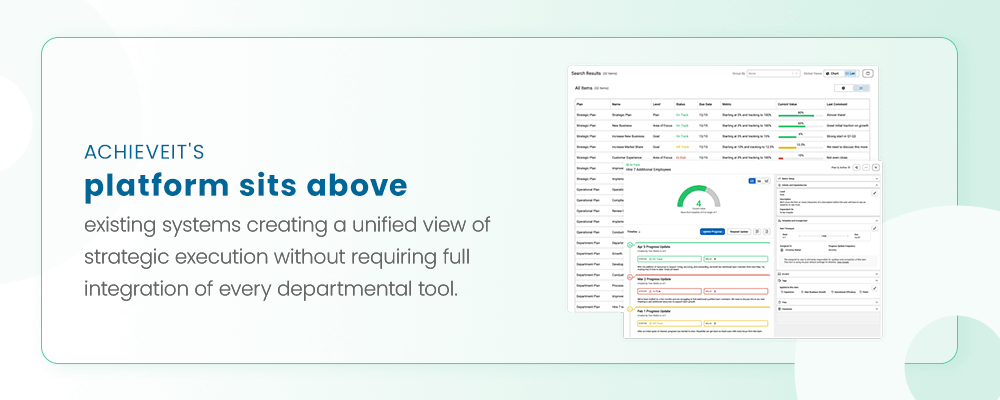
AchieveIt’s platform provides this layer. It sits above existing systems such as electronic health records, enterprise resource planning and finance software, creating a unified view of strategic execution without requiring full integration of every departmental tool.
Case Study — Agnesian Healthcare
During Agnesian Healthcare’s leadership meetings, leaders spent 90% of their time reviewing status updates, leaving only 10% for actual decision-making and corrective action. They had the strategy and the capable people, but lacked a system that made progress visible without manual effort. With AchieveIt, they automated update collection and generated monthly reports that the system sent to leaders before meetings.
The flip was immediate. Meetings shifted to 90% action and 10% review. Reallocating time created a ripple effect across the organization, leading to increased focus and engagement on initiative completion.
Overcoming Roadblocks in Healthcare Strategy Implementation
Before directing their teams to execute plans, leaders must address the obstacles that routinely slow progress, obscure accountability and retrigger reactive management. Watch for these three roadblocks.
Resistance to Change
Departments protecting their budgets and workflows might resist any initiative that requires them to share progress publicly or hold them accountable for accomplishing systemic goals.
Since manual updates, lengthy meetings and surveillance-style reporting make accountability unnecessarily burdensome, the solution is to reduce the friction of participation.
- Implement automated updates: Automated update requests require minimal time from busy clinical staff. Resistance drops when providing a status update takes 30 seconds instead of 30 minutes.
- Use dashboards: Teams that demonstrate visible progress get more resources and attention.
- Celebrate small wins: When increased visibility leads to early recognition rather than blame, departments will quickly see that the system works for them, not against them.
Fragmented Data and System Silos
Even willing departments may struggle to collaborate when their operational data resides in disconnected systems without a shared strategic layer. You can’t resolve this infrastructure challenge by introducing more spreadsheets. The solution is a command-center view that gives leaders a unified picture of progress.
Leadership Engagement at the Department Level
Midlevel and frontline leaders bridge the gap between executive strategy and daily work. Execution stalls when they don’t understand the purpose behind an initiative, lack the authority to make timely decisions or feel excluded from strategy conversations.
A centralized tracking and reporting system directly addresses these problems.
- Enhanced visibility: Integrated dashboards embed the strategic rationale alongside each initiative, so the context is always visible. You can see why the work matters without having to ask.
- Fast decision-making: Real-time tools give department leaders the data they need to act before problems escalate upward. You won’t need to wait for monthly meetings to know something is off track.
- Real-time goal updates: Continuous visibility into shared goals moves leaders from chasing information to being active participants. When you can see progress in real time, you’re part of the execution process rather than a bystander waiting to report.
Driving Sustainable Healthcare Performance Improvement
Strategy execution in healthcare is a genuine challenge. The cost of getting it wrong emerges in missed initiatives, frustrated leadership and — at its most serious — worse patient outcomes.
The methods and infrastructure covered in this piece aren’t aspirational. Health systems use them today to achieve lifesaving results. Research across hospital systems found that patient mortality is approximately 25% lower in the best-performing hospital trusts than the worst-performing ones.
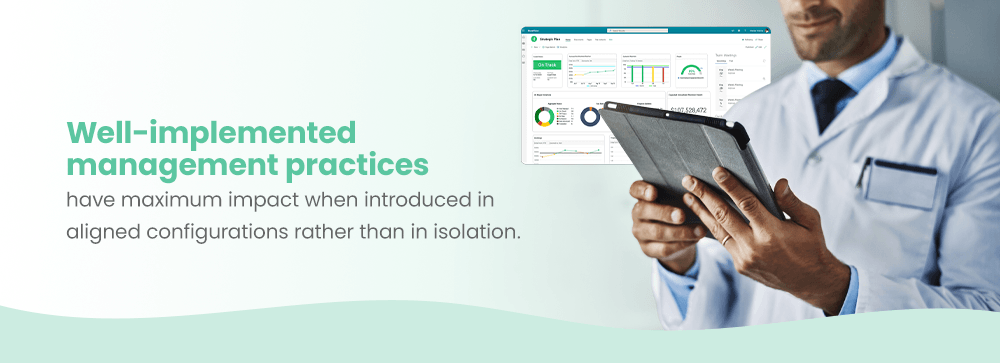
Well-implemented management practices have maximum impact when introduced in aligned configurations rather than in isolation. Ideally, your chosen platform will create those optimal conditions, centralizing and automating tracking, structuring collaboration and providing real-time visibility that benefits patients and health providers.
Successfully Execute Healthcare Strategies With AchieveIt
AchieveIt is purpose-built to turn strategic planning into measurable action by connecting, managing and implementing and initiatives across healthcare organizations. The platform automates update collection, generates dashboards that display on-track and at-risk metrics and gives leadership the ability to drill down from enterprise-wide goals to individual department initiatives in seconds.
Healthcare systems nationwide use our tools to implement strategy at the ground level, closing the gap between what leadership envisions and what frontline teams execute.
Are you ready to see how it works? Take a self-guided product tour to see firsthand how to execute your plans in AchieveIt. Or, explore our healthcare plan execution solutions to learn how we support health systems, hospitals and public health departments.