
Strategic planning in healthcare comes up in nearly every board meeting and leadership conversation — often presented as the solution to growth challenges, operational inefficiencies and competitive pressures. But if you’re newer to healthcare leadership or stepping into a strategy-focused role for the first time, the specifics can feel surprisingly murky.
Many chief strategy officers, COOs, hospital administrators and other leaders wonder what effective healthcare strategic planning entails and how it differs from general business strategy. According to the American Hospital Association, only 8% of healthcare leaders are very effective at strategy and execution. This statistic highlights a significant gap.
Understanding what healthcare strategic planning is and how to approach it effectively separates organizations that consistently improve from those that struggle to make progress. Read along to learn what healthcare strategic planning is, what it looks like in practice and how to approach it effectively. You’ll walk away with the framework you need to lead strategic conversations confidently and recognize what separates planning from execution.
In This Article
- Understanding the Value of Healthcare Strategic Planning
- The Importance of Performance Measurement in Hospital Management Strategy
- Best Practices for Effective Healthcare Strategic Planning
- How Mount Carmel Health System Executed Its Healthcare Strategy
Understanding the Value of Healthcare Strategic Planning
Healthcare strategic planning is the process of defining an organization’s direction and making decisions that align with its long-term goals. For hospitals and health systems, this means setting a clear vision for where the organization needs to be in three to five years, then mapping out the priorities, resources and actions required to get there.
The purpose of strategic planning in healthcare is to guide daily operations, shape resource allocation decisions and keep leadership teams aligned around shared outcomes. It helps organizations manage an increasingly complex landscape with constantly shifting regulatory requirements, reimbursement models, community health needs and competitive pressures.
Planning often unfolds over several months and involves input from clinical leaders, department heads, board members and frontline staff. The result is a documented plan that guides decision-making across the organization, with built-in annual reviews and updates.
How Healthcare Strategic Planning Differs From General Business Strategy
Healthcare strategic planning operates in a fundamentally different environment than general business strategy. It is inherently more complex because the consequences of decisions carry ethical weight that extends beyond financial performance.
- Mission-driven purpose: Healthcare organizations exist to serve patients and communities, not purely to maximize profit. Revenue matters, but it has to align with clinical quality and community health outcomes in ways that complicate traditional return-on-investment calculations.
- A far wider stakeholder universe: Every strategic decision has to account for patients, physicians, nurses, staff, payers, regulators, community members and boards of trustees.
- Regulatory complexity: Government regulations, value-based care mandates, CMS reimbursement policies and HIPAA compliance impact every choice. Plans must anticipate regulatory shifts and be flexible enough to adapt when policies change.
- The ethical weight of decisions: Strategic choices in healthcare directly affect patient health and community well-being, thus creating a higher accountability standard and a longer planning horizon than many commercial industries require.
The Core Components of a Healthcare Strategic Plan
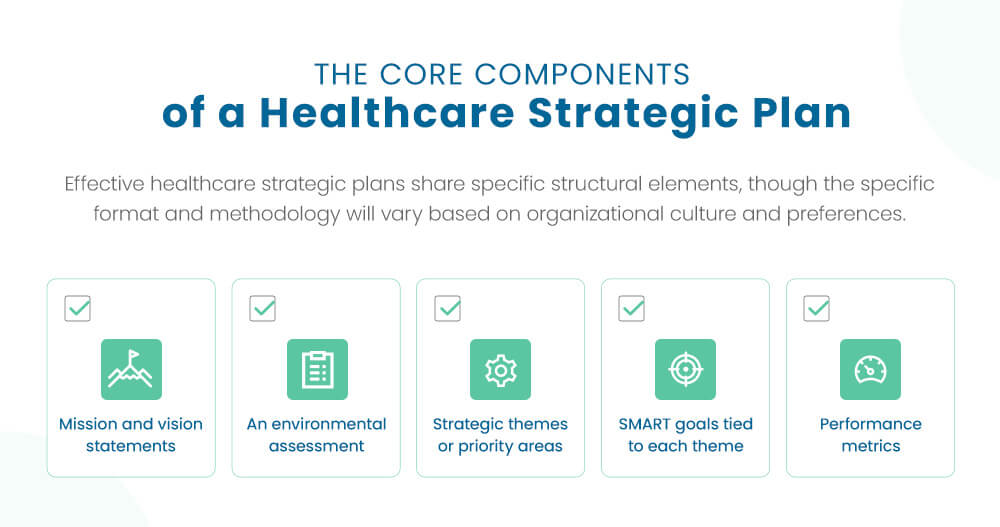
Effective healthcare strategic plans share specific structural elements, though the specific format and methodology will vary based on organizational culture and preferences. What matters is that the plan connects vision to execution in a way the organization can follow.
- Mission and vision statements: The mission defines why the organization exists, while the vision describes what success looks like in the future. These statements are the North Star that keeps strategic decisions aligned with organizational identity.
- An environmental assessment: Analyze internal strengths and weaknesses alongside external opportunities and threats. Any healthcare strategic plan must account for internal forces, such as staff, patients and board members, and external forces, such as technology, government regulations and payers. The SWOT framework is common here, but the insights matter more than the format.
- Strategic themes or priority areas: Most effective plans identify no more than five themes that become the organization’s primary focus areas. These might include clinical excellence, access expansion, operational efficiency, community health or financial sustainability. When everything is a priority, nothing is.
- SMART goals tied to each theme: Break every objective into specific, measurable, achievable, relevant and time-bound targets. These should be concrete enough to assign ownership and track progress.
- Performance metrics: Metrics provide the scoreboard that tells leadership whether the strategy works or needs adjustment.
The Importance of Performance Measurement in Hospital Management Strategy
A plan without tracking is just a document. Performance measurement transforms strategy from aspiration into accountability by creating a feedback loop that allows leadership to track progress and course-correct in real time.
When healthcare organizations establish clear metrics tied to strategic objectives, they create visibility into what works well and what needs attention. Leaders can see patterns, spot emerging problems before they escalate and allocate resources where they will have the most significant impact.
Healthcare KPIs and Metrics to Track
Many healthcare organizations have a board of directors that holds the management team accountable, using a wide range of metrics to track whether they have successfully implemented priorities. The specific KPIs vary, but these are among the most commonly monitored indicators that signal whether the strategy translates into results.
- Patient satisfaction scores: The Hospital Consumer Assessment of Healthcare Providers and Systems survey measures patient experience across dimensions such as staff responsiveness and cleanliness. Low scores indicate service delivery problems that strategic initiatives should address.
- 30-day readmission rates: This metric tracks how often patients return to the hospital within 30 days of discharge. Lower readmission rates signal better care coordination and discharge planning.
- Operating margin: Declining financial health and sustainability margins signal the need for strategic intervention, whether through cost reduction or revenue growth initiatives.
- Staff retention and turnover rate: High turnover disrupts continuity of care, increases recruitment costs and signals workforce dissatisfaction.
- Patient safety metrics: Hospital-acquired infection rates, adverse events, falls and medication errors directly reflect clinical quality. These affect patient outcomes and regulatory standing.
- Average length of stay: When tracking how long patients remain hospitalized, shorter stays typically indicate efficient care delivery. Nonetheless, balance the metric against readmission rates and patient outcomes to avoid unintended incentives.
How Measurement Drives Accountability and Continuous Improvement
Measurement creates the structural discipline that separates strategic execution from strategic aspiration.
- Accountability through ownership: When a metric has a named owner and a timeline, it moves from abstract goal to managed initiative. Someone is responsible for the result, and that clarity drives follow-through.
- Improvement through feedback loops: Regular review of KPIs lets teams identify what works and what’s stalling before it becomes a bigger problem. Monthly or quarterly check-ins create opportunities to course-correct, reallocate resources or escalate issues that need executive intervention.
- The reporting challenge: Many healthcare organizations still track strategic performance through spreadsheets and email chains, creating lag time between real-time activity and leaders’ awareness of it. Automated processes make it easier to see connections between different initiatives.
Best Practices for Effective Healthcare Strategic Planning
Effective healthcare strategic planning goes beyond having a well-written document. It requires intentional approaches to how you build the plan, who you involve, what data informs your decisions and how you sustain momentum.
Engage Stakeholders Early
Ownership drives execution in ways that top-down mandates may not. That’s why clinical leaders, department heads, physicians and frontline managers should be on board from the start.
Plans that don’t account for clinical realities rarely survive contact with the floor. Since physicians influence patient outcomes and implement strategic initiatives, their engagement is critical.
In practice, board and C-suite leaders own the vision while operational leaders own the execution. Both are necessary from Day 1. A steering committee composed of eight to 10 people, including representatives from across the organization, ensures strategic decisions reflect real-world constraints and capabilities.
Early engagement also builds buy-in. People whose input created the strategy will be far more likely to champion it in their departments.
Ground Decisions in Data
Effective strategic plans need a foundation of honesty. Complete inward-looking and outward-looking audits to assess where your organization stands.
- Internal operational performance: Review current financial position, clinical outcomes, staff capacity and technology infrastructure. Understanding where you are today reveals what needs to improve.
- External market dynamics: Analyze community health needs, demographic trends, competitive landscape, regulatory changes, payer dynamics and emerging technologies.
- Financial and resource constraints: Evaluate available capital and physical space. Strategic ambitions must align with realistic resource availability.
- Community and patient feedback: Gather input through surveys, focus groups and health needs assessments.
Vague aspirations like “improve patient satisfaction” provide no direct target. Choose specific, measurable objectives to track, such as “increase HCAHPS scores from 72% to 80% within 18 months.”
Build In Accountability and Flexibility
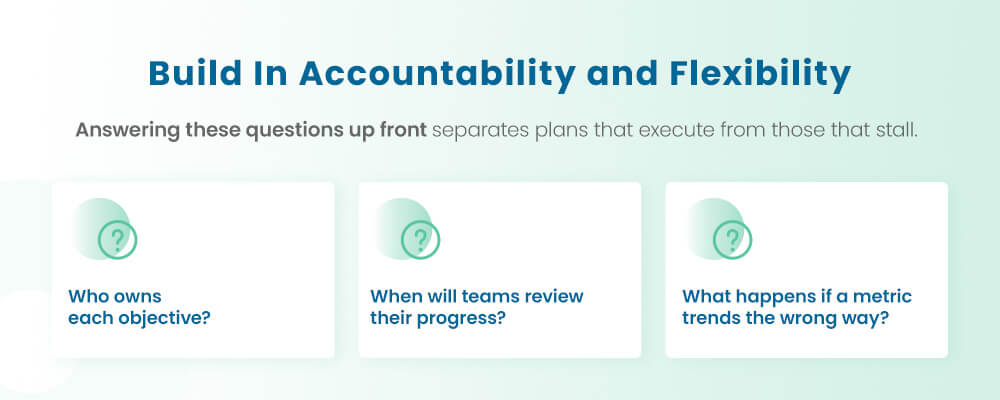
Accountability and flexibility work together to create an effective healthcare strategy. Every goal should have a named owner, a timeline and a review cadence, and the plan should be versatile enough to adapt when circumstances change.
The execution gap often emerges not because strategies are insufficient, but because plans lack structured accountability. Who owns each objective? When will teams review their progress? What happens if a metric trends the wrong way? Answering these questions up front separates plans that execute from those that stall.
Strategic plans should be dynamic and fluid, revisited regularly rather than locked in a drawer after the annual planning retreat. Monthly or quarterly check-ins let organizations catch drift before it leads to failure. These reviews create space to ask specific team members or groups whether their initiatives are on track and if a change warrants a strategic response or a simple tactical adjustment.
Keep Your Plan Connected Across Departments
Healthcare organizations are structurally complex. A strategy that lives in the C-suite but never reaches department heads or service line leaders will stall before it gains traction.
Cross-departmental alignment means every team understands how their work connects to the organization’s broader goals and can see their progress. Coordination becomes possible when finance, clinical operations, quality improvement and IT all work from the same framework. When they operate in silos, even well-designed strategies fragment.
Strategic initiatives in healthcare are specific projects and operational improvements that move the organization toward its strategic objectives. These initiatives often span multiple departments and require cross-functional coordination to achieve.
Strategic planning software helps organizations maintain this visibility by creating a single place where all departments can see how their initiatives connect to organizational goals. Without that structure, cross-departmental alignment in healthcare relies on manual coordination that rarely scales across complex health systems.
How Mount Carmel Health System Executed Its Healthcare Strategy
Mount Carmel Health System in Central Ohio provides a good example of a well-executed strategic plan in healthcare. The organization serves more than 1 million patients through a network that includes 10,000-plus employees, 2,000 physicians and 900 volunteers. Despite that scale, it had a visibility problem.
- The challenge: Individual practices were completely disconnected from the system’s overarching strategic goals. Plans lived in physical binders created by outside consultants. When people left, they took their institutional knowledge with them, leading to fragmented and incomplete reporting. Mark Vorherr knew the organization was essentially proceeding by guesswork when he came aboard as president.
- The solution: Vorherr chose AchieveIt to create annual operating plans for each fiscal year, tying his group’s work directly to Mount Carmel’s top four strategic goals and their “4 P’s” — people, population, performance and portfolio. Vorheer tapped 40 leaders to own specific objectives and tactical work, with a structured update cadence built into the platform.
- The result: Mount Carmel now has a single source of truth for comprehensive reporting. They can track year-over-year visibility into how individual work drives strategic goals at the system level. The medical group moved from flying blind to genuine organizational maturity.
Connect, Manage and Execute Your Healthcare Strategy With AchieveIt
Healthcare strategic planning is an ongoing cycle of setting direction, measuring progress, holding teams accountable and adapting when conditions change. Organizations that master this cycle consistently outperform those that still cobble together strategies using spreadsheets and email chains.
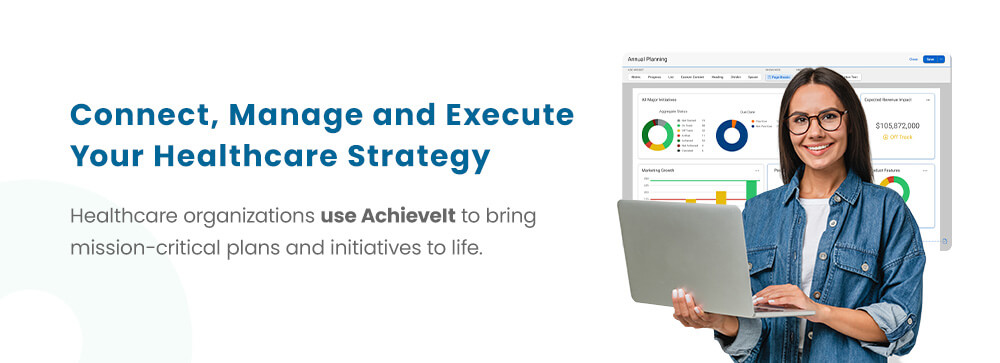
Healthcare organizations use AchieveIt to bring mission-critical plans and initiatives to life. The platform bridges cross-departmental gaps, letting you manage progress in real time and execute strategy with the visibility and accountability that manual processes can’t match.
Whether you oversee a systemwide strategic plan or cross-functional projects, AchieveIt adapts to your organization’s planning structure and keeps everyone aligned on what matters most. Request a demo or take a self-guided product tour to see firsthand how to execute your plans with AchieveIt.