

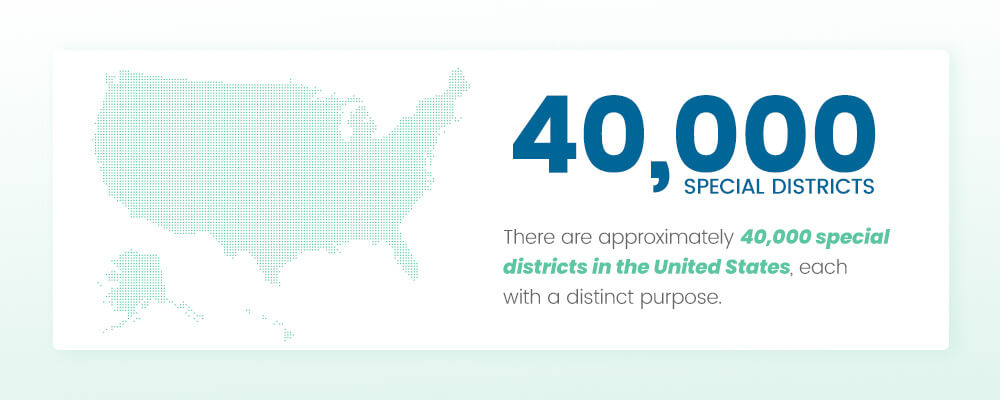
There are approximately 40,000 special districts in the United States, each with a distinct purpose. These independent governmental entities serve critical community needs that cities and counties often can’t address alone.
Because of their fragmented nature, limited visibility and constrained resources, special districts face specific challenges when balancing long-term projects with day-to-day services. If you’re curious about what sets these entities apart, this blog offers a special district overview.
In This Article
- Understanding Special Districts
- What Are Special Districts?
- Types of Special Districts
- How Special Districts Operate
- Why Special Districts Matter to Communities
- The Unique Responsibility of Special Districts in Local Governance
Understanding Special Districts
Often called shadow governments, special districts are distinct from other government entities. What sets them apart is their singular focus.
While cities and counties juggle multiple responsibilities, special districts concentrate on one critical function — whether that’s delivering clean water, maintaining parks or providing emergency services.
Some special districts cover large areas, while many operate in small communities. Together, they serve diverse rural, urban and suburban areas. All must maintain critical infrastructure while adapting to rapidly changing technologies.
What Are Special Districts?
Special districts are local governments that provide specific services, such as libraries, water management or fire protection. These entities fill service gaps that general-purpose governments cannot address. They empower local communities to tailor services and infrastructure to their needs.
These districts have more autonomy than other entities. Governed by elected or appointed boards, special districts have legal authority to levy taxes, impose fees and issue debt. Special districts have several defining characteristics.
- Specialized services: They focus on a single set of services that governments may not adequately provide.
- Fiscal independence: They maintain governing boards with the authority to issue bonds and manage finances independently of other municipal governments.
- Geographic area: They operate across specific geographical boundaries, often crossing municipal lines to address regional needs.
- Corporate power: They can enter into contracts, employ staff and sue or be sued.
- Accountability: They answer to voters or landowners within their district. Entities must follow state laws regarding public meetings, records and financial reporting.
- Funding autonomy: Revenue comes from property taxes, special assessments or user fees directly related to the service provided.
Governance structures fall into two categories. Independent districts operate with high autonomy, featuring elected boards and their own revenue sources. Dependent districts remain tied to a parent government, with appointed boards and budgets managed by a city or county council.
Types of Special Districts
Special district types are diverse, reflecting the varied needs of American communities. Understanding these types helps leaders recognize operational patterns and challenges.
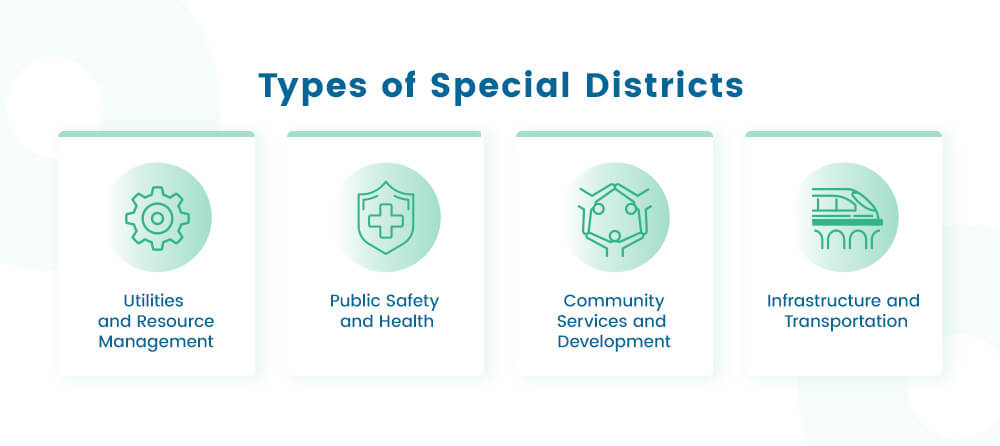
Utilities and Resource Management
These districts handle essential resources. Examples include:
- Water supply districts ensure clean drinking water reaches homes and businesses.
- Sewer and sanitation districts manage wastewater treatment and disposal.
- Irrigation districts serve agricultural communities.
- Drainage and flood control districts protect property from water damage.
- Electric utility districts bring power to areas underserved by private companies.
Public Safety and Health
Public health and safety districts protect communities around the country:
- Fire protection districts, like the Arcata Fire District in California, provide specialized fire prevention and suppression services.
- Emergency medical services districts offer rapid response times when it matters most.
- Vector control districts, such as mosquito abatement, protect public health by managing disease-carrying pests.
- Healthcare districts operate within community hospitals and clinics.
Community Services and Development
These community-based districts aim to improve quality of life for their residents:
- Parks and recreation districts manage public spaces and programs, from neighborhood playgrounds to regional sports complexes like the Alta Canyon Sports Center.
- Library districts dedicate resources to building and maintaining robust public library systems.
- Cemetery districts such as the Antimony Cemetery Maintenance District handle burial grounds and memorial services.
- Housing and community development districts address affordable housing needs.
Infrastructure and Transportation
Transport and infrastructure districts keep communities moving:
- Public transit authorities operate bus and rail systems in urban and suburban areas.
- Port authorities manage harbors and shipping facilities.
- Airport districts oversee aviation infrastructure.
- Road maintenance districts handle everything from pothole repairs to major resurfacing projects in unincorporated areas.
How Special Districts Operate
Special district governance follows state-defined frameworks. A principal act, or set of statutes, authorizes each type of special district as a political subdivision. This legal foundation outlines its governance structure, powers and limitations. Principal acts provide district consistency while allowing for local adaptation.
Governance models fall between elected and appointed leadership. Independent districts typically feature boards elected by constituents, giving them the authority to manage affairs autonomously. Dependent districts operate under parent government control, with city or county officials appointing board members and overseeing budgets.
Funding mechanisms reflect the “beneficiary pays” principle.
- User fees: Enterprise districts bill customers directly for water, sewer, electric and sanitation services.
- Property taxes: Many districts receive ad valorem tax allocations to fund services like fire protection.
- Special assessments: Additional property taxes cover specific improvements, like streetlights and landscaping, within defined areas.
- Bonds: Districts issue general obligation bonds backed by property taxes and revenue bonds paid from user fees for capital projects.
- Grants: Federal and state funding support infrastructure, particularly in rural or underserved regions.
Financial reserves ensure stability through emergencies and economic downturns. This approach links costs directly to those who benefit, distinguishing special districts from general-purpose governments, which spread expenses across all taxpayers.
Relationships with other government entities vary. Independent districts maintain fiscal separation but may share geographic areas with cities or counties. This overlap can lead to either efficient coordination or service duplication. Some districts rely on parent governments for tax collection, while others operate entirely independently.
Why Special Districts Matter to Communities
Special districts deliver tangible benefits that improve daily life for residents and businesses, including:
- Tailoring services to citizen demand rather than applying one-size-fits-all solutions.
- Linking costs directly to benefits, ensuring funding only where users pay for services.
- Responding quickly to constituent needs through focused governance.
- Providing essential infrastructure and utilities that might otherwise go unmet.
- Crossing county lines to address regional issues needing coordinated action.
- Improving safety and quality of life through specialized expertise.
- Hiring expert professionals who focus solely on the district’s function.
- Reacting faster to specific community needs, such as emergency repairs or local disasters.
This focused approach translates to better service outcomes and more efficient resource use. For example, a water district’s engineers concentrate exclusively on water quality and delivery systems.
The Unique Responsibility of Special Districts in Local Governance

Special districts occupy a distinct space in American governance. Their flexibility allows communities to address specific needs without expanding the general government bureaucracy. Unlike cities and counties, which juggle competing priorities, these entities maintain a sharp focus on their specific purpose.
Special districts maintain financial independence by raising revenue through property taxes and customer fees. Many municipalities use special districts to reduce general city debt, thereby improving municipal bond ratings and fiscal health. This structure benefits the special district and the parent jurisdiction.
Interested in learning how these essential entities serve your community? Consider exploring your local special districts. Their work often happens behind the scenes, but their impact shapes everything from the water in your tap to the parks where your children play.
Streamline Special District Management With AchieveIt
Managing a special district’s complex operations requires more than spreadsheets and email chains. AchieveIt helps special district leaders turn plans into results with strategy execution and performance management software.
Our platform reduces manual processes, increases performance visibility, improves accountability on key initiatives and streamlines reporting across departments. We offer special districts solutions to support project management and deliver measurable ROI.
Ready to see how AchieveIt simplifies execution? Take our self-guided product tour or request a demo today.