
State agencies often operate as separate islands. Each department tracks separate priorities and works autonomously while the overarching mission drifts. This fragmentation produces duplicated work, misaligned priorities and delayed decisions. It undermines the ability to demonstrate that the state government functions as a single, coordinated entity.
Breaking down walls in state government requires intentionality and operational infrastructure. Culture alone cannot overcome legacy systems that trap data in separate places. Technology is not enough to shift the assumptions and incentives that keep agencies apart. This guide explores the mindset shifts and platform capabilities state government leaders need to move from fragmented coordination to unified execution.
The Challenge of Silos in State Government
State governments struggle to implement coordinated strategies that involve multiple agencies — 76% of leaders say walls between departments are the top barrier to achieving strategic initiatives. Operational silos emerge when agencies function as separate islands with no shared view of what’s happening across the state. Each department keeps its information separate, even from other groups with similar goals.
State government leaders can identify three types of silos blocking coordinated execution.
- Strategic: Individual department goals prioritize internal success over state outcomes. Budget structures discourage cross-agency investment because funding flows through vertical channels that reward departmental results.
- Social: Unclear working relationships and inconsistent communication fragment teams across agency lines. Without cross-agency coordination, collaboration depends on personal relationships that disappear when people leave the organization.
- Technical: Legacy systems lock agencies into disconnected processes and workflows. Data lives in departmental databases that can’t communicate with each other, preventing real-time visibility into statewide execution.
Centralized tracking and strategy execution platforms can solve this challenge, allowing departments to work efficiently with a shared commitment to transparency and accountability.
Understanding Operational Silos and Their Impact
Government silos don’t form because people are unwilling to collaborate. They exist because systems operate around vertical accountability. Leaders who understand these three root causes can address the problem at its source rather than treating symptoms.
1. Organizational Structure
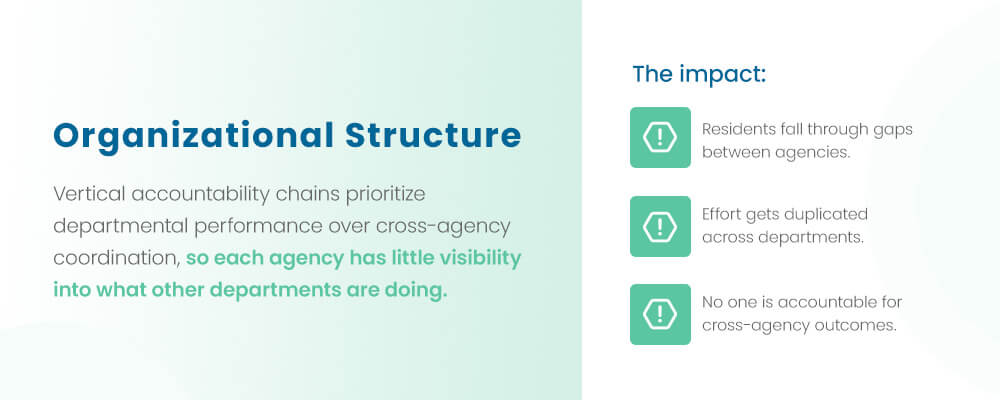
Vertical accountability chains prioritize departmental performance over cross-agency coordination, so each agency has little visibility into what other departments are doing. Performance metrics reward agencies for hitting departmental targets, creating incentives that reinforce isolation rather than collaboration.
The impact:
- Residents fall through gaps between agencies.
- Effort gets duplicated across departments.
- No one is accountable for cross-agency outcomes.
2. Legacy Systems
Technology built for individual agencies can’t communicate across boundaries. Data gets trapped in departmental silos even when leaders want to share it. Systems that operate to solve agency-specific problems become obstacles to statewide coordination.
The impact:
- Shared goals stall in technical bottlenecks.
- Front-line workers make decisions with incomplete information.
- Caseworkers manually reenter data that they can’t pull across systems.
3. Cultural Barriers
Operational silos aren’t just a technology problem. Three cultural elements work together to keep agencies apart:
- The assumptions agencies carry — information is private by default
- The incentives they respond to — metrics rewarding vertical performance rather than shared outcomes
- The relationships they haven’t built — collaboration depending on individual initiative rather than institutional design
The impact:
- Collaboration depends on individuals, not systems — and often stops when specific people leave.
- Individual departments bear the risk of sharing with little reward for doing so.
- Residents may experience the government as fragmented and unresponsive.
The Importance of Collaboration in State Government
The U.S. Government Accountability Office defines collaboration as any joint activity intended to deliver more public value than entities could produce acting alone. This definition shifts the focus from process to outcomes.
3 Ways Collaboration Delivers Public Value
Breaking down silos in government operations yields concrete benefits that justify the investment in collaborative infrastructure.
- Improved policy coherence: When agencies share goals and can see each other’s work, their initiatives reinforce one another. Achieving state priorities prevents conflicting departmental interpretations and duplicated efforts.
- Resource optimization: Shared insights across agencies quickly identify duplicated efforts, enabling proactive reallocation of resources. Leaders can move resources from redundant tasks to fill critical gaps.
- Enhanced citizen services: Coordinated agencies respond faster and more holistically to public needs because their work is visible and accountable. As a result, citizens experience government as a unified system rather than as disconnected departments.
Building the Foundation for Collaboration
Fostering state government collaboration starts with leaders who model and incentivize it while building the infrastructure that makes teamwork possible.
While GAO developed its eight leading practices for federal agencies, the framework also works well for state challenges.
- Define common outcomes: Set shared targets that agencies must reach together — objectives that no single department can achieve alone.
- Ensure accountability: Define who is responsible for projects that involve multiple agencies. Track progress so everyone knows who is doing what and whether they are meeting goals.
- Bridge organizational cultures: Build shared language, metrics and reporting standards that allow agencies with different operating norms to work together.
- Identify and sustain leadership: Name senior leaders who remain responsible for joint projects, even if team members change.
- Clarify roles and responsibilities: Create a record that persists even when people leave. Write down who makes decisions, who executes tasks and who needs to approve.
- Include relevant participants: Make it easier for different agencies to pitch in on projects that affect them, without relying on personal connections to get things done.
- Leverage resources and information: Show what each agency can do, how much it spends and its results. This helps leaders decide how best to use money and staff.
- Develop and update written guidance and agreements: Maintain living documentation of shared protocols and formalize collaboration through written agreements.
Centralized Tracking and Strategy Execution as Solutions
Centralized government tracking systems provide transparency, real-time data and unified reporting across agencies. They replace siloed spreadsheets and disorganized email chains with a single source of truth that makes progress visible to everyone who needs to see it. When implemented effectively, these platforms serve as the operational infrastructure that enables the execution of government strategy at scale.
- Define common outcomes: A smart system provides agencies with a shared space to collaborate and document statewide goals. It links each agency’s goals to bigger aims.
- Ensure accountability: A shared platform allows everyone to see who is responsible for what, what is on schedule and what has fallen behind.
- Bridge organizational cultures: Tracking systems foster the adoption of shared language, metrics and reporting standards. Agencies can easily collaborate, even if they have different standard operating procedures.
- Identify and sustain leadership: Even if a leader leaves, the platform saves all their plans, promises and responsibilities, so others know how to pick up the slack.
- Clarify roles and responsibilities: Every project has a specific owner, and every goal has someone responsible for it. The system allows leaders to define who makes decisions and who performs tasks.
- Include relevant participants: Leaders can easily invite different departments to join initiatives.
- Leverage resources and information: A centralized tracking system gathers information from all agencies. It shows how much work they can do, how much they spend and their results. Leaders can then see where resources go and where they duplicate efforts.
- Develop and update written guidance and agreements: The software acts as a central, up-to-date place for official agreements, shared rules and written contracts.
How Washington State Unified Data Strategy Across More Than 200 Agencies
Washington State noticed that agencies weren’t sharing data effectively, making it difficult to coordinate decisions. So, the state decided to build a new, unified data plan from the ground up. More than 200 leaders and partners from various agencies created this plan through workshops, advisory groups and cross-agency collaboration.
The new 2025 data plan set up a system for agency teams to create and manage statewide goals. Washington built it collaboratively, rather than mandating it from the top down. This approach created buy-in across agencies and ensured the framework addressed genuine operational challenges rather than theoretical concerns.
5 Best Practices for Breaking Down Silos in Government
State government leaders ready to move from fragmented coordination to unified execution can implement five concrete practices that address cultural and technical barriers.
1. Establish Shared Strategic Goals Across Agencies
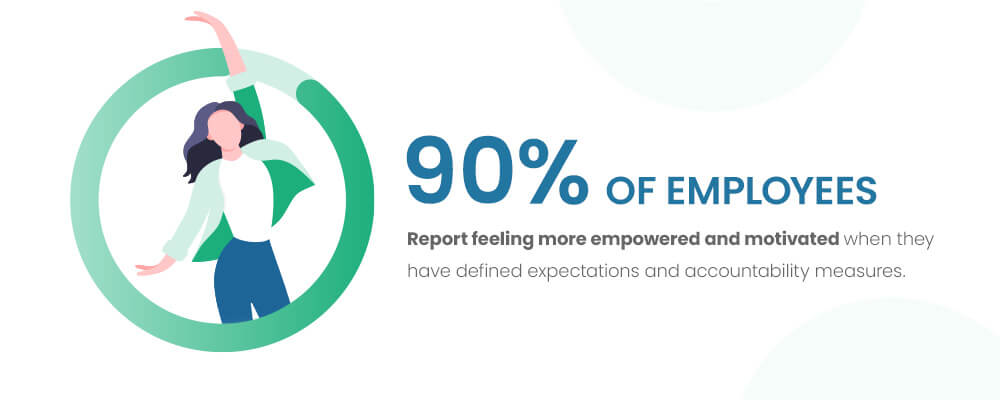
Before selecting any platform, leaders must agree on what they’re working toward. This cooperative approach can pay dividends because 90% of employees report feeling more empowered and motivated when they have defined expectations and accountability measures.
Without a coordinated foundation, centralized government tracking only provides a clearer view of disconnected activity.
This practice in action: Utah wanted to ensure shared goals didn’t rely solely on informal agreements or individual relationships, so the state codified them into law. Legislation now requires the legislative and executive branches to work together to create and publish performance measures for funded programs.
2. Implement Integrated Communication and Collaboration Platforms
Replace email and spreadsheets with a centralized system where all agencies input updates, track progress and can see each other’s work in real time. The system should make sharing information simple and automatic, so it doesn’t feel like busywork.
This practice in action: Iowa set out to unify IT operations across state government by consolidating 20 separate IT shops into a single platform. The chief information officer described the goal as finally being able to see the flow of work across state government on a single pane of glass.
3. Encourage Cross-Departmental Teams and Joint Accountability Structures
When different groups plan together, review each other’s work and form teams, it creates shared responsibility. Cross-agency collaboration prevents responsibility from staying locked in single departments.
This practice in action: North Carolina formed the Governor’s Advisory Committee. This group includes three department heads, senior officials, legislators and performance experts who advise on plans, check policies and ensure consistent performance management across the state.
4. Leverage Data-Driven Decision-Making and Continuous Improvement
Use real-time dashboards to identify what’s working, proactively reallocate resources and course-correct quickly. Make the data visible to everyone who needs it, not just executives.
This practice in action: Massachusetts built a Public Health Data Warehouse integrating data from hospitals, prisons, social services and insurers — over 6 billion records total. They used it to design an evidence-based medication program across seven county jails, which reduced all-cause mortality by 50%.
5. Address the Cultural Layer Directly
This practice sets the foundation for all the rest. Shift assumptions by defaulting to transparency rather than information hoarding. Realign incentives by tying recognition and performance reviews to shared outcomes. Build cross-agency relationships before you need them, not during a crisis. Normalize new habits through visible and consistent leadership.
This practice in action: When Massachusetts built its Public Health Data Warehouse, officials deliberately chose to treat contributing agencies as experts rather than mere data sources. They brought IT, legal and public health staff into shared decision-making from the start. Many attribute the project’s success to the cultural shift away from information hoarding and toward genuine collaboration.
Moving From Fragmented Coordination to Unified Execution
Cultural shifts, such as new ways of thinking, better rewards and stronger relationships, lay the foundation for cooperation. But culture alone can’t fix legacy computer systems that keep data separate, nor can it give leaders the quick view they need to manage work across different agencies.
Central tracking and platforms clarify who works together and who is responsible. These systems require everyone to use the same language and metrics, and they retain relevant information when people leave, enabling different agencies to participate.
State government leaders who invest in cultural and technological aspects will be in a better position to deliver on their mission, demonstrate coordinated progress to legislators and the public and build the trust that effective government requires.
Break Down Silos With the Help of AchieveIt
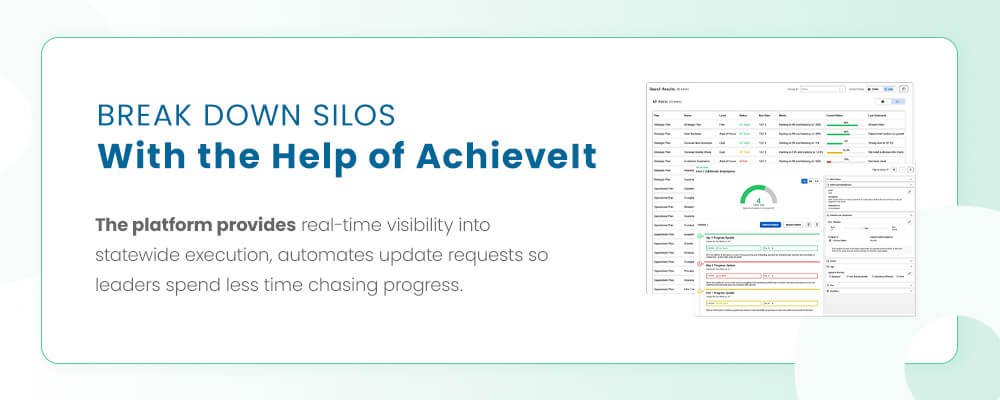
AchieveIt helps state governments connect, manage and execute plans and initiatives across agency lines. The platform provides real-time visibility into statewide execution, automates update requests so leaders spend less time chasing progress and more time making decisions and creates a central hub where cross-agency collaboration becomes the default rather than the exception.
Request a demo to see how AchieveIt enables leadership practices and centralized tracking that break down silos or take a self-guided product tour to see firsthand how to execute your plans in AchieveIt.